
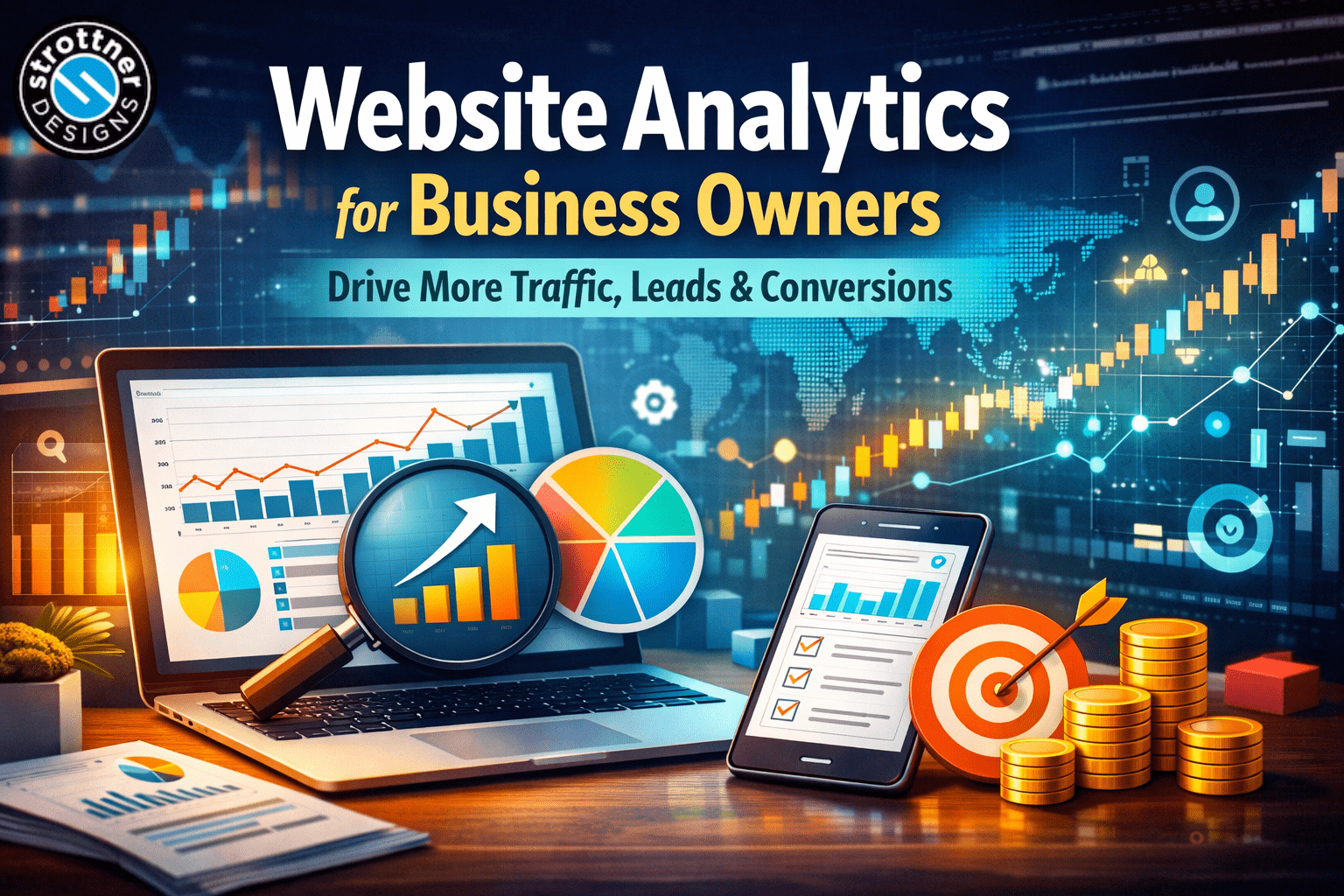
Your website is trying to tell you something.
Not in a haunted-house way. More in a “hello, I have useful information that could help you make money” way.
Every day, your website collects clues about how people find you, what they care about, where they get stuck, and what convinces them to take action. That information lives in your website analytics. And if you know how to read it, it can help you make smarter marketing decisions, improve your website, and turn more visitors into leads and customers.
That’s why website analytics for business owners matters so much.
Most business owners know they should be looking at analytics, but many are not sure what they’re looking at. They log into a dashboard, see traffic numbers, graphs, bounce rates, and acronyms that sound mildly threatening, then quietly back away and decide they will deal with it another day.
The good news is that website analytics does not have to be complicated. You do not need to become a full-time data analyst or suddenly develop strong feelings about spreadsheets. You just need to understand which numbers matter, what those numbers mean, and how to use them to improve your website’s performance.
At Strottner Designs, we help businesses build websites that are not just attractive, but strategic. That means we care about what your website is doing, not just how it looks. A great website should bring in the right audience, guide them clearly, and convert interest into action. Analytics is how you measure whether that is actually happening.
In this guide, we will break down website analytics for business owners in plain English. You will learn which metrics to track, how to understand visitor behavior, and how to use data to get more traffic, more leads, and better conversions without losing your mind in the process.
Website analytics is the data that shows how people interact with your website.
It tells you things like:
In simple terms, website analytics helps business owners understand what is working and what is not.
Without analytics, you are making decisions based on guesses. With analytics, you can make decisions based on real user behavior.
That difference is huge.
Maybe you think your homepage is doing all the heavy lifting, but your analytics show that your service pages are where most leads start. Maybe you assume social media is your strongest traffic source, but organic search is actually bringing in the best prospects. Maybe you think your website just needs more visitors, when the real problem is that current visitors are not being guided toward action.
Website analytics for business owners is not about collecting more numbers just to feel productive. It is about turning those numbers into better business decisions.
Business owners do not need more information for the sake of information. They need useful insight.
That is what makes website analytics so valuable.
Your website is often the first impression people have of your business. It is where potential customers learn who you are, what you offer, and whether they trust you enough to take the next step. If your site is confusing, slow, unclear, or poorly structured, analytics will often reveal that long before a customer sends you a polite email explaining why they left. Which, to be fair, almost never happens.
Instead, people just disappear.
Analytics helps you understand why.
When business owners track website performance consistently, they can answer important questions like:
These are not small questions. They affect how you spend your marketing budget, how you prioritize updates, and how effectively your website supports your business goals.
If you want more leads, better return on investment, and a website that actually pulls its weight, website analytics is not optional. It is essential.
There are a lot of metrics available in most analytics platforms. Some are useful. Some are distracting. Some look impressive in a report and tell you almost nothing.
Here are the website analytics metrics business owners should pay the closest attention to.
These metrics tell you how many people are visiting your site and how often.
A user is an individual visitor.
A session is a visit.
So one person visiting your site three times could count as one user and three sessions.
Why it matters:
This gives you a basic picture of your website’s reach and activity. If traffic is growing over time, that is generally a good sign. But traffic alone is not the goal. Relevant traffic is the goal.
A spike in visitors can look exciting, but if none of those visitors are turning into leads or customers, the number is not especially helpful. It is like throwing a party where the house is full but nobody brought snacks or knows why they came.
Traffic sources show where your visitors are coming from.
This often includes:
Why it matters:
This is one of the most useful parts of website analytics for business owners because it shows which marketing channels are actually driving visits.
More importantly, it helps you compare quality.
For example, maybe paid ads are bringing in lots of traffic, but visitors from organic search spend more time on your website and convert at a higher rate. That tells you something important about audience intent. One channel may be bringing volume, while another is bringing buyers.
That kind of insight helps you invest your marketing dollars more wisely.
A landing page is the first page a visitor sees when they arrive on your site.
Many business owners assume everyone enters through the homepage. That is rarely true. Visitors often land on blog posts, service pages, portfolio pages, or local SEO pages.
Why it matters:
Your top landing pages are often your true front door.
If those pages are getting traffic, they need to do more than exist. They need to clearly explain the topic, support the visitor’s intent, and lead them toward the next step. If a page brings people in but gives them no reason to continue, it is missing an opportunity.
For business owners, this is a major analytics insight. You may discover that a page you barely think about is doing more work than your homepage ever has.
These metrics help you understand whether visitors are actually engaging with your content.
Are they reading?
Scrolling?
Clicking?
Exploring multiple pages?
Why it matters:
If visitors stay for a while and interact with your site, that often means the content is relevant and the experience is working. If they leave almost immediately, that can point to a mismatch between what they expected and what they found.
Maybe the page loaded slowly.
Maybe the content was too vague.
Maybe the headline promised one thing and the page delivered another.
Maybe the design felt cluttered.
Maybe the copy was trying too hard to sound impressive and forgot to be helpful.
That last one happens more than it should.
This is one of the most important website analytics metrics for business owners.
A conversion is any action you want a visitor to take, such as:
Your conversion rate tells you what percentage of visitors complete that action.
Why it matters:
This is where website performance connects directly to business results.
You can have a beautiful website and solid traffic numbers, but if nobody takes action, something is broken. Conversion rate helps you measure whether your website is doing its actual job.
Even small improvements in conversion rate can make a big difference. If your site gets 1,000 visitors a month and your conversion rate increases from 2 percent to 4 percent, you just doubled your results without increasing traffic.
That is the kind of improvement business owners tend to appreciate very quickly.
A bounce usually means a visitor came to one page and left without taking another action on your site. Exit pages show the last page someone viewed before leaving.
Why it matters:
These metrics can reveal friction points.
If people keep exiting on your pricing page, something may be unclear or unconvincing. If blog readers arrive, skim, and leave, the content may not match search intent or include a clear next step. If your contact page gets traffic but not submissions, there may be usability issues or trust gaps.
Not every bounce is bad. Sometimes people find what they need and leave satisfied. But when important pages have high exits and low conversions, they deserve attention.
This is where website analytics becomes especially powerful for business owners.
You can track actions such as:
Why it matters:
These smaller actions help you understand how people move through your website before they convert.
Sometimes visitors are interested, but something interrupts the path. Event tracking helps you find those weak points. Maybe people click your CTA but abandon the form. Maybe they scroll through the page but never see the offer. Maybe mobile users tap around like they are trying to crack a safe.
The better you understand those behaviors, the easier it is to improve them.
One of the biggest advantages of website analytics for business owners is that it helps you measure your marketing based on results instead of assumptions.
Every business invests time or money into marketing. SEO, content creation, email campaigns, social media, paid ads, referral partnerships, and local search all funnel people toward your website. Analytics shows what happens after they arrive.
That matters because clicks are not enough.
A campaign is not successful just because it generated traffic. It is successful when that traffic turns into meaningful business outcomes.
For example:
If your SEO strategy is working, you should see organic traffic growing, landing pages performing well, and visitors from search taking action.
If your blog content is working, you should see readers arriving through helpful articles, staying engaged, and moving toward service pages or contact forms.
If your email campaigns are working, you should see targeted traffic that already knows who you are and is more likely to convert.
If your paid ads are working, they should bring in visitors who justify the cost through leads or sales.
This is where website analytics becomes more than a reporting tool. It becomes a decision-making tool.
It helps business owners stop asking, “How do we get more traffic?” and start asking, “How do we attract the right traffic and turn it into revenue?”
That is a much better question.
Let’s save you some frustration.
Here are a few common mistakes that can keep business owners from getting real value out of their analytics.
Traffic, impressions, reach, and page views can all be useful. But they are not the whole story.
If your traffic grows but your leads stay flat, that growth is not helping the business.
Website analytics for business owners should focus on performance metrics that tie back to actual outcomes, not just numbers that look nice in a screenshot.
A metric by itself does not mean much.
A high bounce rate might be normal on one page and a warning sign on another. A drop in traffic might be a problem, or it might reflect seasonality. A page with fewer visits might still be your highest-converting asset.
Context matters. Trends matter. Comparisons matter.
You do not need to obsess over analytics every day, but you do need to review performance regularly.
For most business owners, a monthly review is a smart rhythm. It is frequent enough to catch trends and issues, but not so frequent that every tiny fluctuation feels like a crisis.
Because not every small traffic dip is a five-alarm fire. Sometimes it is just Tuesday.
A newsletter signup is useful. A consultation request may be more valuable. A sale is even more valuable.
Your analytics should reflect what success actually looks like for your business. Otherwise, you may end up optimizing for actions that feel busy but do not meaningfully support growth.
This is the part business owners care about most, and rightly so.
Here is how to use website analytics to improve conversions and get more value from your website.
Find the pages that attract the most visitors. Then look at what those pages do next.
Do they clearly explain what you offer?
Do they answer likely questions?
Do they build trust?
Do they guide people to a clear next step?
If not, start there.
Updating a high-traffic page with stronger copy, a better CTA, clearer structure, trust signals, FAQs, or internal links can produce outsized results because the traffic is already there.
If visitors reach a service page but do not contact you, investigate the experience.
Maybe the offer is unclear.
Maybe the messaging is too generic.
Maybe the page is trying to say everything at once.
Maybe the form asks for too much too soon.
Maybe the mobile layout is awkward.
Maybe the CTA button says “Submit,” which has all the emotional power of a parking receipt.
Analytics helps you spot these points of friction so you can improve them strategically.
If one blog topic consistently brings in qualified traffic, create more content around that subject.
If one service page converts well, study why. If one traffic source outperforms the others, lean into it.
A lot of marketing growth comes from paying attention to what is already working and doing more of it, not from chasing every new trend that wanders by wearing sunglasses.
Search behavior is changing. Traditional SEO still matters, but people are also using AI-powered search tools and assistants to ask questions in more natural language.
That means your content needs to be useful, clear, well-structured, and easy to understand.
This is where website analytics supports both SEO and AI search visibility.
If your analytics show that people are finding your content through search, staying engaged, and moving deeper into your site, that is a strong sign your content aligns with search intent.
If visitors arrive on educational blog posts and then navigate to service pages, that suggests your content is doing more than attracting clicks. It is building trust and supporting conversion.
For business owners, this is the sweet spot.
You want content that can rank, be referenced, be understood by AI systems, and still lead real people toward action. That usually means creating pages that:
Analytics tells you whether that strategy is actually working.
A monthly website analytics review does not need to be complicated.
Business owners should regularly review:
The goal is not to generate a beautiful report that nobody uses. The goal is to answer a few practical questions:
What is improving?
What is underperforming?
What is attracting qualified traffic?
What is converting?
What should we adjust next?
Those questions keep your website tied to business goals instead of drifting into the land of vague marketing optimism.
Website analytics for business owners is not about becoming obsessed with dashboards. It is about understanding how your website supports growth.
It helps you see where traffic comes from, how visitors behave, which pages pull their weight, and where conversions are won or lost. It gives you the clarity to make better decisions about your website, your content, and your marketing investments.
Most importantly, it helps you move from guessing to knowing.
And that is where better results begin.
At Strottner Designs, we build websites that are designed to do more than look polished. We create strategic websites and content that help businesses attract the right audience, communicate clearly, and convert visitors into real opportunities. Then we use data to keep improving performance over time.
Because the best websites are not built on hope alone.
They are built on insight, strategy, and a clear understanding of what your audience is doing once they arrive.
If you are getting traffic but not enough leads, or if your website analytics feel more confusing than helpful, Strottner Designs can help. We design websites and content strategies that turn data into direction, so your business can attract better traffic, improve conversions, and grow with more confidence.
Your website already has a story to tell.
Let’s make sure it is telling the right one.

Interested in a new site and SEO, or just a new site? Visit Home of the Free Website to learn how we can build you a free or affordable site.

Privacy Policy | Sitemap | Terms of Use