
Once upon a time, search intent felt fairly tidy.
A person typed “best plumber near me,” and you knew they needed a plumber. Someone searched “what is SEO,” and you knew they wanted information. If they typed “buy office chairs,” congratulations, they were probably ready to spend money and possibly ruin a Saturday assembling furniture.
Those days are not gone, exactly. But they are a lot messier now.
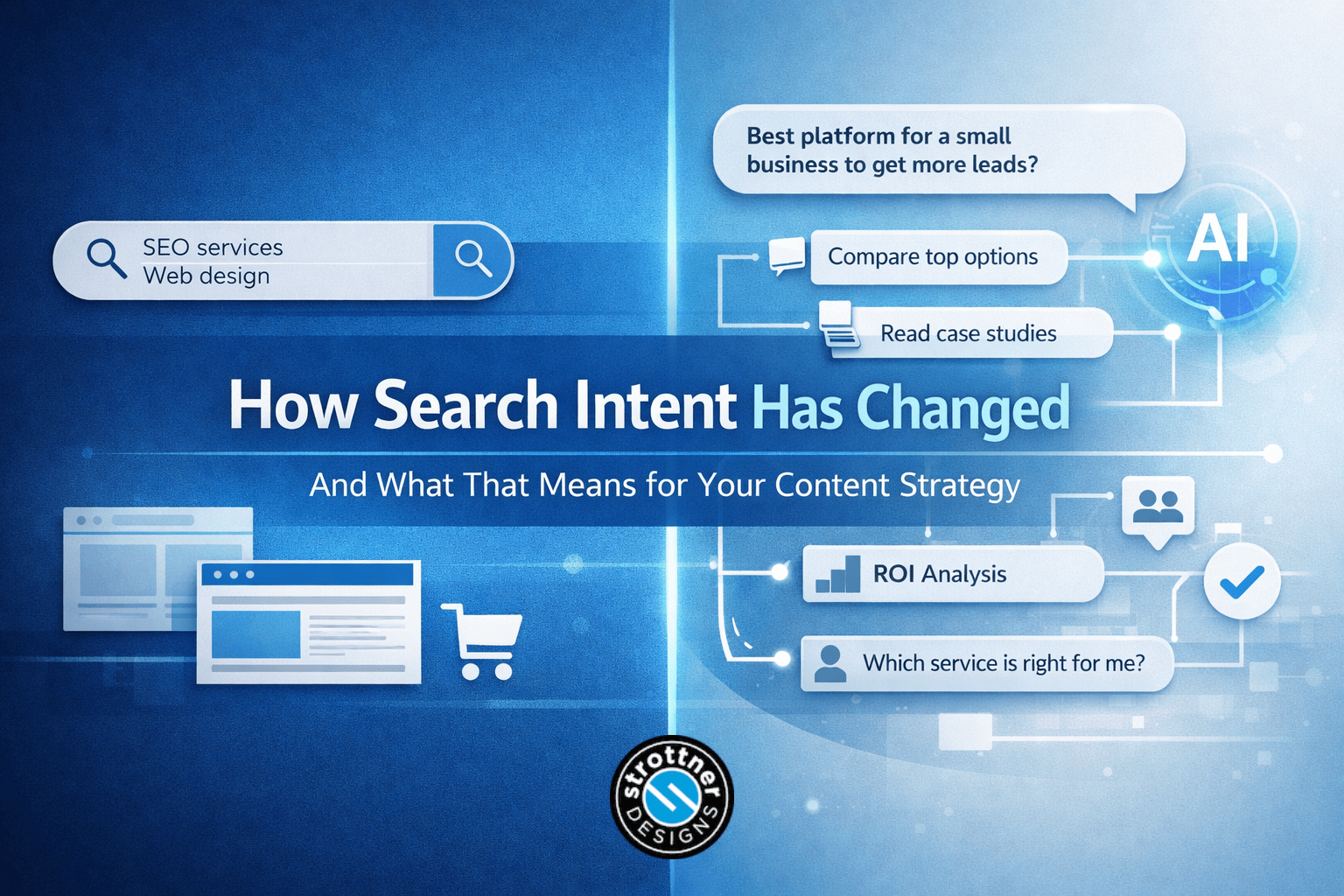
Search intent has changed because search behavior has changed. People no longer search in a straight line. They ask longer questions. They compare options in more detail. They refine their thinking as they go. They use AI-powered search experiences, voice, images, and follow-up prompts to move from curiosity to decision faster than before.
That shift matters for one simple reason: if your content strategy still treats search intent like it is frozen in 2019, your content will be answering yesterday’s questions in today’s search environment.
And that is a great way to publish useful content that nobody finds, or worse, content people find and quickly abandon because it does not match what they actually need.
Let’s talk about what has changed, why it matters, and what businesses should do about it.
Traditional SEO often grouped search intent into a few familiar buckets:
Those categories still matter. They are still useful. But they are no longer enough by themselves.
Why? Because the path between “I want to learn” and “I want to buy” is much less linear than it used to be.
A person might start with a broad question, see an AI-generated overview, ask a more specific follow-up, compare providers, read reviews, visit a service page, leave, come back through another query, and then convert after seeing one strong case study or trust signal.
In other words, intent is no longer just a label attached to one keyword. It is often a moving target across a sequence of searches.
That means content strategy has to stop thinking only in terms of keywords and start thinking more in terms of decision journeys.
A search query can now carry more than one kind of intent at the same time.
Take a search like:
“best website platform for a small law firm that wants more leads”
That’s not just informational. It’s not purely commercial either. It is part research, part evaluation, part strategy, and part buying signal.
The user wants an answer, but they also want guidance. They may be early in the process, but they are clearly headed somewhere specific.
This is one of the biggest changes in search intent. Queries are increasingly richer, more detailed, and more nuanced.
That changes what “good content” looks like.
A thin article that gives a generic answer is less likely to satisfy someone asking a layered question. Today’s searcher often wants context, comparison, examples, and next steps, not just a definition and a few filler paragraphs pretending to be insight.
This is where things get interesting for marketers.
Search used to separate discovery and decision into clearer stages. One page educated. Another page sold. The handoff was slower and more obvious.
Now those moments are collapsing together.
That means searchers are often arriving with more context than before.
They may already know the basics. They may have already seen a summary. They may have already compared broad options before they ever land on your site. By the time they click through, they may be asking deeper questions like:
This is why content strategy cannot stop at traffic. The job is no longer just getting the click. The job is meeting the visitor at the exact level of intent they bring with them.
Think of it like greeting someone at a party. If they walk in saying, “I’ve already read three reviews, compared two vendors, and checked your pricing philosophy,” you do not start with “Hello, would you like to know what marketing is?”
AI-driven search experiences are training users to expect faster clarity.
People are getting used to synthesized answers, broader context, and immediate follow-up opportunities. That doesn’t mean websites are obsolete. It means websites have to do more than repeat basic facts.
If your blog post is just a warmed-over version of what everyone else already said, it is less likely to stand out in search and less likely to earn trust from a reader who has already seen the summary elsewhere.
The bar is higher now.
Good content needs to do at least one of these things well:
The internet does not need another 1,200-word article that says “SEO is important because it helps your business get found online.” We know. Even your dog probably knows.
This does not mean keywords are dead. They are not. They still matter because language matters. Search still depends on relevance, clarity, and matching what people are looking for.
But the old model of building one page around one phrase and calling it strategy is wearing thin.
Why? Because intent is broader than the exact wording of a query.
Someone searching “why is my website getting traffic but no leads” may need help with SEO, messaging, UX, conversion strategy, audience targeting, or all of the above. The winning content is not the page that repeats the phrase the most times. It is the page that understands the actual problem behind the phrase.
That is where modern content strategy has to mature. You are not only mapping keywords. You are mapping motivation.
That means asking better planning questions, such as:
When you approach intent this way, your content becomes more useful and more convertible.
That is not a coincidence.
One of the biggest practical shifts is this: a single piece of content may need to support more than one intent stage at once.
For example, a blog post on “How Much Should a Small Business Spend on SEO?” may attract an informational searcher. But that person is also likely evaluating providers, budget expectations, ROI, and timing. So the post cannot just explain what SEO is. It has to help them think through investment, expectations, tradeoffs, and next steps.
That is where many businesses miss the mark.
They create top-of-funnel content that is too shallow to build trust, or service pages that jump straight into selling without answering the real questions people ask before they are ready.
The better approach is to create content ecosystems, not isolated pages.
That looks like this:
In other words, stop making every page fend for itself like it has been abandoned in the woods. Build a system.
The keyword is the surface. Intent is the substance.
If someone searches “SEO vs PPC for home services,” they probably do not want a textbook comparison. They want to know which option fits their timeline, budget, competition, and lead goals. Write to that.
Today’s searchers often arrive ready for nuance. Give them specifics. Address tradeoffs. Include examples. Explain when the answer changes based on context.
A strong article should feel less like a dictionary entry and more like a smart conversation with someone who knows the terrain.
Do not just publish one article and hope it carries the whole load. Create connected content that supports awareness, evaluation, and decision.
For a design and marketing firm, that might mean linking a blog post about search intent to related pages on SEO services, web design strategy, PPC, or conversion-focused website development.
The old SEO win was getting the click from Google. The new win is helping the visitor know what to do next.
That means strong internal linking, relevant calls to action, proof points, and copy that reduces uncertainty.
Many older blog posts were written for simpler, flatter search behavior. They may still bring in traffic, but they often underperform because they do not answer enough of the real decision-making questions modern searchers bring.
Refreshing these pieces can be one of the fastest wins in content strategy.
Here are a few warning signs:
Your page gets impressions but very few clicks.
That may mean the title or framing does not match current search expectations.
Your page gets traffic but weak engagement.
That may mean visitors do not see their real question answered quickly enough.
Your blog attracts readers but not leads.
That may mean the content informs without guiding.
Your service pages convert poorly.
That may mean they ask for action before they build enough trust.
Your content sounds accurate but generic.
That may mean it is technically relevant but strategically forgettable.
That last one deserves some attention. Generic content is one of the biggest risks in the AI search era. If your page sounds like it was assembled from common advice and polite filler, it may be easy for search systems to summarize and easy for humans to ignore.
The smartest content strategies now balance two goals:
Be discoverable.
Show up for the questions your audience is actually asking.
Be decisive.
Help the reader move forward with clarity and confidence.
Those two goals used to sit farther apart. Now they often happen in the same session, on the same page, or within a very short journey.
That means your content should not just rank. It should resolve.
It should help the user feel, “Yes, this answered my question. Yes, I understand my options. Yes, I know what to do next.”
That is the sweet spot.
Search intent used to be more like a filing cabinet.
Now it is more like a conversation.
People do not just search for facts. They search for clarity, reassurance, comparison, validation, and direction. They ask broader questions, then narrower ones. They explore, refine, and decide in quicker cycles.
So what does that mean for your content strategy?
It means you need content that understands where the searcher is headed, not just what they typed.
It means better structure, better specificity, better internal journeys, and more useful answers.
It means less filler, less keyword tunnel vision, and less content written only because “we should probably post a blog this month.”
And yes, it means your content has to work a little harder now.
But that is not bad news.
It is an opportunity.
Because when most businesses are still creating content for old-fashioned search behavior, the brands that adapt early get to look sharper, sound smarter, and earn trust faster.
At Strottner Designs, that is where strong content strategy should live: at the intersection of SEO, messaging, user experience, and conversion. Not as separate tasks, but as one connected system.
Because the goal is not just to be found.
The goal is to be useful enough to matter and clear enough to win the next step.
And that is what modern search intent is really asking for.
Is your content strategy built for how people search today?
At Strottner Designs, we help businesses create content that aligns with modern search behavior, improves visibility, and turns traffic into real opportunities. From SEO strategy and website content to conversion-focused messaging, our team can help you build content that works harder. Contact us today!

Interested in a new site and SEO, or just a new site? Visit Home of the Free Website to learn how we can build you a free or affordable site.

Privacy Policy | Sitemap | Terms of Use