

There was a time when business blogging felt pretty simple.
Write a post about marketing.
Then one about branding.
Then one about web design.
Then maybe one about productivity, leadership, holiday trends, or whatever sounded interesting that week.
For a while, that approach could work. Publishing regularly was often enough to give your site some fresh content, target a few keywords, and bring in a little search traffic.
That is no longer enough.
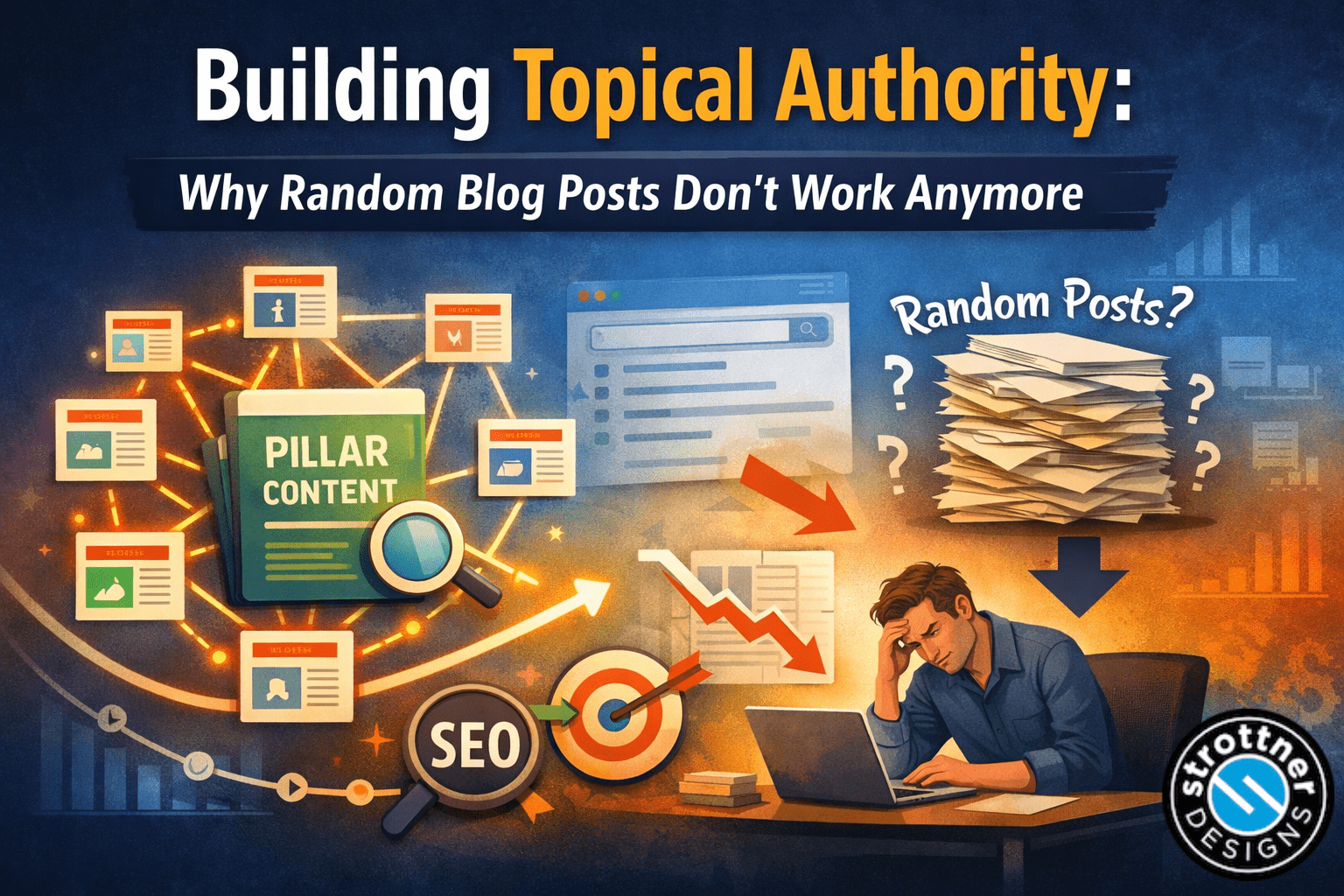
Today, building topical authority is one of the most important content strategies for businesses that want stronger SEO, better visibility, and more qualified traffic. If your blog is full of disconnected posts that do not support each other, your content is not building momentum. It is just taking up space.
That is the problem with random blogging.
At Strottner Designs, we help businesses create websites and content strategies that are built to perform. And one of the biggest shifts in modern SEO is this: publishing often matters far less than publishing with purpose.
If your blog posts are scattered, your authority will be too.
In this guide, we will break down what building topical authority actually means, why random blog posts do not work the way they used to, and how to create a smarter content strategy that helps your business rank better, build trust, and drive more conversions.
Topical authority is the credibility your website builds around a specific subject.
In simple terms, it means your site becomes known for covering a topic clearly, consistently, and in depth. Instead of publishing one-off blog posts on unrelated subjects, you create a connected body of content around the topics that matter most to your audience and your business.
For example, if your company wants to be known for SEO and website strategy (know anyone like that?), your content should not bounce randomly between web design one week, company culture the next, and a generic holiday post after that. It should stay focused on topics that reinforce your expertise, such as:
Each post supports the others. Each topic adds depth. Together, they help search engines and potential customers understand what your business knows and why your website deserves attention.
That is the foundation of building topical authority.
To be fair, random blog posts were not always a terrible strategy.
A few years ago, search engines were less sophisticated, competition was lower, and publishing new content regularly could help businesses target a wider range of keywords. For many sites, simply being active was enough to get some traction.
Back then, volume often mattered more than structure.
But search has changed.
Search engines now do a much better job of understanding context, user intent, topic depth, and the relationships between pages. They are not just looking for a keyword match anymore. They are trying to determine whether a website appears genuinely useful and credible on a subject overall.
That means scattered content is less effective than it used to be.
A site with one post about SEO, one about branding, one about social media, one about workplace morale, and one about office snacks may technically have a blog. But it does not create a strong signal of expertise in any one area.
And human readers notice that too.
When someone lands on your site, they are asking themselves whether you seem knowledgeable, trustworthy, and relevant to their needs. A random blog does not build that confidence very well. It feels less like a valuable resource and more like a drawer full of miscellaneous cables.
There might be something useful in there. Finding it is another matter.
Building topical authority matters because both search engines and users are looking for depth, not just activity.
A website with a connected library of useful content around a subject sends a stronger signal than a website with dozens of unrelated articles. That signal helps establish relevance, trust, and expertise.
This matters for several reasons.
If your business wants to be known for SEO, web design, branding, or digital strategy, your content should reinforce that positioning.
Random blog posts blur your message. Building topical authority sharpens it.
When your content consistently covers related subjects, your website becomes more clearly associated with those topics. Search engines understand your focus better, and readers are more likely to view your business as a credible source.
One post can answer one question. A topic-based content strategy can answer many related questions in a way that supports the full customer journey.
Someone might start by reading a post about what topical authority is, then move on to how topic clusters work, then read about internal linking, then explore your content strategy services.
That path is much easier when your content is connected.
Building topical authority is not just about ranking. It is about creating a better experience for users who want to learn, compare, and eventually take action.
One of the biggest benefits of building topical authority is that related content naturally links together.
A post about topic clusters can link to one about internal linking. A post about content strategy can link to one about SEO planning. A post about blog structure can link to one about converting traffic into leads.
Those links help users navigate your site and help search engines understand how your content fits together.
Random blog posts make this much harder. You end up with isolated articles instead of a connected content ecosystem.
Random content can attract random visitors.
That may sound fine on paper, but traffic alone is not the goal. Qualified traffic is the goal. You want readers who are interested in the topics tied to your expertise and services, not just anyone who happened to click a broad article once.
Building topical authority helps you attract people who are more likely to engage, trust your business, and convert.
When your blog lacks structure, planning becomes messy.
What do you write next?
How does it connect to previous posts?
Does it support your services?
Can it be linked to other articles?
Does it move readers any closer to becoming a lead?
Without a clear topical strategy, content planning becomes reactive. You publish whatever sounds good in the moment and hope it adds up to something later.
Usually, it does not.
Building topical authority gives your content plan direction. It turns blogging from a series of isolated tasks into a system.
Building topical authority does not mean repeating the same phrase 40 times and calling it a strategy. It means covering a core topic from multiple useful angles.
Let’s say your business wants to build authority around website SEO.
A random content approach might include:
A strategy focused on building topical authority might include:
The second approach creates depth. It makes the website easier to understand and more likely to build momentum over time.
That is what strategic content looks like.
Building topical authority improves SEO because it helps search engines understand what your website is about and how thoroughly you cover a subject.
That matters more than ever.
Search engines are evaluating more than individual pages. They are also evaluating the context around those pages. A single article may rank for a query, but a collection of related, well-structured content often creates stronger signals of expertise and relevance.
When you focus on building topical authority, your site is better positioned to:
This is why random blogging has become less effective. It may produce occasional traffic, but it rarely creates a meaningful SEO advantage.
Building topical authority creates that advantage by showing search engines that your website is not just touching a topic. It understands the topic.
Building topical authority also matters for AI-powered search experiences.
AI search tools are increasingly designed to surface clear, well-structured, context-rich content. They are better at understanding relationships between topics and identifying sources that appear consistently useful in a given area.
That means websites with focused, connected content are in a stronger position than sites with scattered articles.
If your blog contains a well-organized body of content around a subject, it becomes easier for AI systems to interpret what your business knows and when your content may be relevant to a user’s question.
This is another reason building topical authority is so important now.
It supports traditional SEO, but it also prepares your content to perform better in a search environment that is becoming more conversational, more semantic, and more context-driven.
The good news is that building topical authority does not require publishing endless blog posts just to keep up appearances. It requires a smarter structure.
Here is how to begin.
Start with the topics most closely tied to your services, expertise, and ideal audience.
Ask yourself:
These answers will help define your core topic areas.
For a business like ours that might include SEO, web design, content strategy, website analytics, branding, and conversion optimization.
Those topics create the foundation for building topical authority.
Once you identify a main topic, build supporting content around it.
This is often called a topic cluster strategy. You create a central pillar topic and then publish related posts that explore subtopics in more detail.
For example:
Core topic: Content strategy
Supporting content:
Each piece strengthens the others. Together, they create a more complete signal of relevance.
Building topical authority is not about publishing lots of thin content around minor keyword variations.
It is about answering meaningful questions your audience actually has.
Think about what potential clients ask before they work with you. Think about what confuses them, what they compare, what they misunderstand, and what they need to know to move forward with confidence.
That is the material worth turning into content.
The best SEO content usually starts with real user needs, not just a keyword list.
Internal links are essential when building topical authority.
Link related blog posts together. Link educational content to service pages. Link broader guides to more specific articles. Help users move naturally from one idea to the next.
These links create structure, improve usability, and help search engines understand how your content is connected.
Without internal links, even good content can feel scattered.
Traffic is nice. Conversions are better.
One of the most important parts of building topical authority is making sure your content aligns with your actual business goals. That means creating content around topics that support your expertise and lead naturally toward your services.
You do not need every post to sound like a sales pitch. You do need each post to make sense within the larger path from discovery to trust to inquiry.
That is the difference between content that attracts attention and content that supports growth.
Consistency still matters. But now it means consistent relevance, not constant randomness.
A smaller library of focused, high-quality, strategically linked content will usually do more for your authority than a larger library of disconnected posts.
Building topical authority is about creating the right kind of consistency. Each piece should strengthen the next. Each topic should contribute to a bigger picture.
That is how content starts working like an asset instead of a chore.
If you are not sure whether your current blog is helping or hurting your authority, here are a few warning signs:
If that sounds familiar, the problem may not be blogging itself.
The problem may be that you are publishing without a structure designed for building topical authority.
Random blog posts are not useless. But they are no longer enough.
If your goal is stronger SEO, better visibility, more qualified traffic, and a clearer path to conversions, building topical authority needs to be part of your content strategy.
That means writing with direction.
Publishing with structure.
Connecting related ideas.
And making sure your content reinforces what your business actually wants to be known for.
The businesses getting the best results from content today are not just posting more. They are building smarter.
They are creating systems, not piles.
And when your blog becomes a connected resource built around real audience needs and real business goals, it stops being filler and starts becoming one of your most valuable marketing assets.
If your blog feels scattered, underperforming, or disconnected from your business goals, Strottner Designs can help. We create strategic websites and content plans designed to improve search visibility, strengthen authority, and turn traffic into real opportunities.
Let’s build content that works together, ranks better, and supports the growth of your business.

Interested in a new site and SEO, or just a new site? Visit Home of the Free Website to learn how we can build you a free or affordable site.

Privacy Policy | Sitemap | Terms of Use