

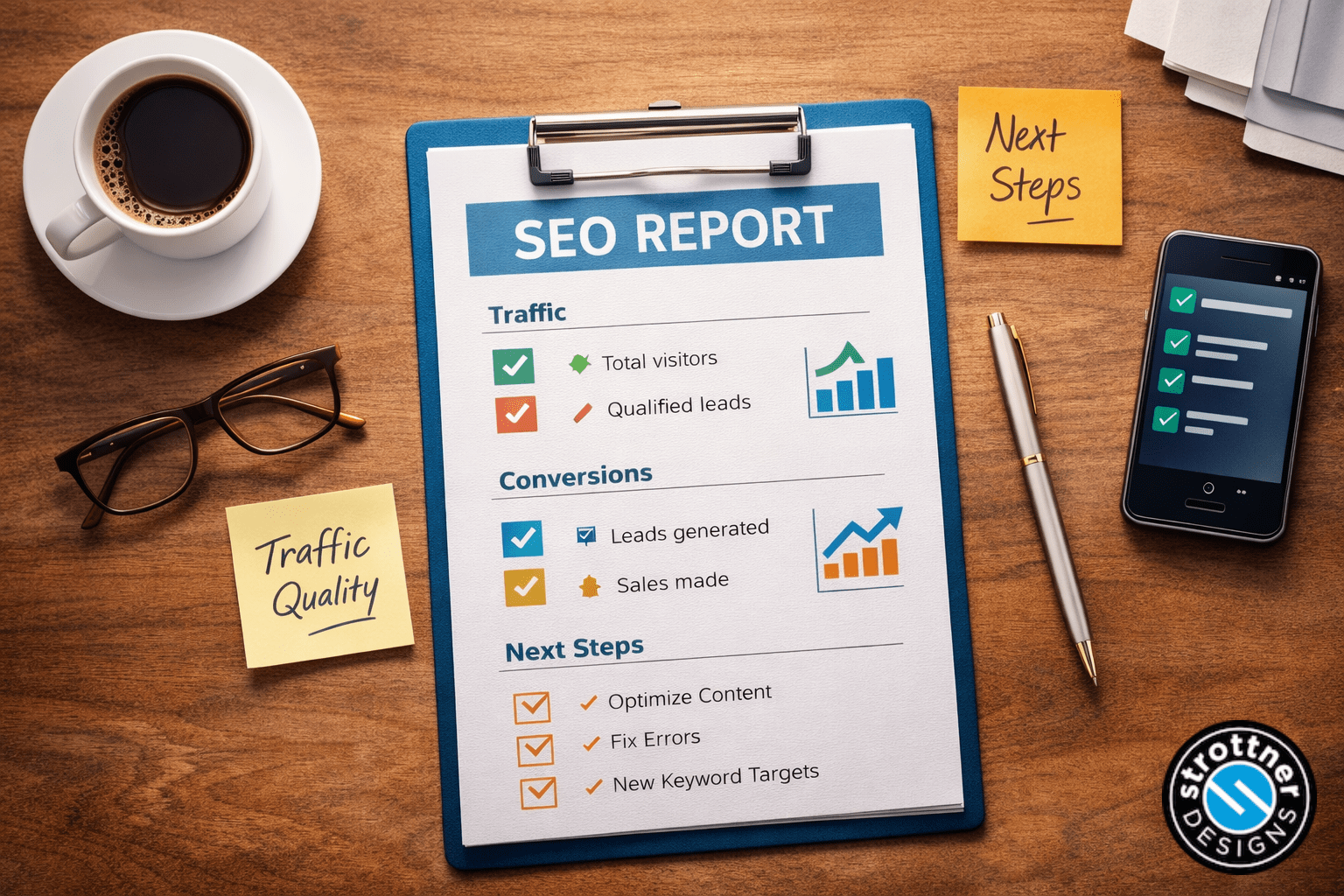
SEO reports are funny things.
On paper, they exist to inform. In reality, a lot of them confuse, overwhelm, or quietly sit unopened in someone’s inbox while everyone hopes traffic just keeps going up.
If you’ve ever looked at an SEO report and thought, “I’m not sure if this is good or bad, but it has a lot of charts,” you’re not alone.
A good SEO report should give you clarity. It should tell you what’s working, what’s not, and what to do next. A bad one just lists numbers and hopes you won’t ask follow-up questions.
Let’s talk about what an SEO report should actually tell you, what it should leave out, and why working with a team like Strottner Designs usually delivers better insight than trying to piece it together on your own.
The job of an SEO report is not to prove that SEO is complicated. It’s to help you make decisions.
A good report answers three simple questions:
If your report doesn’t clearly answer those questions, it’s missing the point.
SEO lives at the intersection of marketing, technology, and human behavior. That means data matters, but only if it connects back to business outcomes. Rankings and impressions are nice. Leads, calls, and sales are better.
Traffic numbers are usually the first thing people look for, and that’s fine. But a good report goes deeper than “up” or “down.”
It should show:
A sudden jump can be great. It can also be a warning sign. A solid report explains why traffic moved, not just that it did.
This is where tools like Google Analytics are useful, but only when someone knows how to interpret what they’re seeing. Data without context is just noise.
Not all rankings are created equal.
A good SEO report doesn’t just list hundreds of keywords and call it a win. It highlights the ones that matter to your business. These are usually keywords with clear intent, especially ones tied to services, locations, or buying decisions.
You should see:
Ranking number one for a keyword no one searches for is not a victory. Ranking number five for a keyword that brings in qualified leads might be.
A strong report makes that distinction clear.
This is where SEO reports often fall apart.
Traffic alone doesn’t tell you much unless you know what happens next. A good report connects SEO performance to user behavior.
It should answer questions like:
This is where SEO and UX overlap. If traffic is growing but conversions are flat, the issue usually isn’t SEO. It’s the experience.
A good report points that out instead of quietly ignoring it.
Every SEO report should include some technical insight. It should not read like a server error log.
You should expect clear explanations around:
Yes, technical SEO matters. No, you should not need a developer background to understand whether something is urgent.
A good report tells you what’s wrong, why it matters, and what fixing it will actually do for your site.
Tools like Google Search Console surface this data. Experience turns it into a plan.
This part is often skipped, which is a mistake.
A good SEO report documents the work that happened during the reporting period. Not in vague terms, but in clear language.
That might include:
More importantly, it explains why those actions were taken. Strategy matters more than activity.
If your report lists tasks but never explains the thinking behind them, you’re not getting the full value.
This is where great reports separate themselves from average ones.
A good SEO report doesn’t end with data. It ends with direction.
You should walk away knowing:
SEO is not set-it-and-forget-it. A report should feel like a checkpoint, not a conclusion.
Impressions. Total keyword count. Average position across hundreds of terms.
These numbers are not useless, but on their own they don’t tell a story. A report that leans too heavily on them often avoids harder conversations about conversions and revenue.
If a metric doesn’t connect back to business impact, it should be secondary, not front and center.
If you need to Google half the terms in your SEO report, that’s a problem.
SEO professionals should be able to explain complex issues in plain language. If they can’t, they either don’t understand it well enough or they’re hiding behind complexity.
Neither is good. We explain all of the terms in our SEO 101 blog series.
“Create more content.”
“Build more links.”
“Improve site speed.”
Thanks. Very helpful.
A good SEO report is specific. It references your site, your market, and your goals. Generic recommendations belong in blog posts, not in reports you’re paying for.
Charts look nice. They are not explanations.
A report full of graphs with no insight is basically homework. A good report tells you what to notice and why it matters.
Even smart teams struggle with SEO reporting in-house. Not because they’re incapable, but because SEO sits across too many disciplines.
It requires:
Most internal teams are busy running the business. SEO reporting becomes something they react to instead of something they use strategically.
There’s also a blind spot problem. When you’re too close to your own site, it’s harder to see patterns, missed opportunities, or structural issues that an outside team notices immediately.
At Strottner Designs, SEO reports are built to be read, not endured.
We focus on:
We don’t just tell you what happened. We tell you why it happened and what to do next.
Because a good SEO report isn’t about proving value. It’s about creating it.
Our clients don’t come to us for spreadsheets. They come to us for clarity, direction, and results they can actually measure.
If your SEO report leaves you with more questions than answers, it’s not doing its job.
A good report should feel like a conversation with someone who understands your business, your goals, and your customers. It should guide decisions, not just document activity.
And if you’re tired of guessing whether your SEO is working, that’s usually a sign it’s time for a different approach.
Strottner Designs helps organizations see what their data is really telling them and, more importantly, how to use it to grow.
If you’d like an SEO report that actually means something, let’s talk.

Interested in a new site and SEO, or just a new site? Visit Home of the Free Website to learn how we can build you a free or affordable site.

Privacy Policy | Sitemap | Terms of Use