
There’s a type of website that quietly holds companies back.
It is not broken.
It’s not embarrassing.
It technically works.
It’s “good enough.”
And that’s exactly the problem.
Across industries, business owners know their site could be better. The site doesn’t fully reflect who they are today. It’s not generating the leads it should. It feels dated. A little slow. A little unclear.
But it’s not a disaster. So it stays.
Another quarter passes.
Then another year.
This isn’t about chasing design trends. It’s about understanding the real cost of settling for a website that’s acceptable instead of effective.
Because “good enough” rarely means neutral. More often, it means expensive.
The biggest cost of a good enough website isn’t maintenance. It’s missed opportunity.
Let’s say your site generates 12 inquiries per month. You close 30 percent. Your average client value is $8,000.
That’s roughly $28,800 in new business monthly.
Now imagine your site generated 20 qualified inquiries instead of 12. Same close rate. Same pricing.
That becomes $48,000 per month.
That’s a $19,200 monthly difference.
Over $230,000 per year.
Most business owners would never ignore that kind of gap in operations. Yet online, it goes unnoticed because the loss isn’t visible. It doesn’t show up as a bill. It shows up as unrealized growth.
That’s the hidden cost.
A lot of websites survive on inertia.
They load. They have pages. The phone rings occasionally. Traffic hasn’t completely disappeared.
So it feels stable.
But stability can be misleading. If your site generates five leads per month, you start planning around five. If it generates ten, you assume ten is the ceiling.
You adapt to underperformance.
Meanwhile, competitors are optimizing for search visibility, improving conversions, building authority, and positioning themselves for AI-driven discovery.
They’re not standing still.
Your website isn’t just competing with local businesses anymore.
It’s competing with:
When someone lands on your site, they’re subconsciously comparing it to the best digital experiences they’ve had recently.
If your site feels slow, confusing, or outdated, it doesn’t feel neutral. It feels behind.
And behind costs trust.
Trust directly affects conversions.
Five years ago, ranking in search often meant having decent content and a few backlinks.
Today, visibility requires structure, clarity, authority, and technical performance.
Search engines are evaluating:
And now, AI-powered search tools are reshaping how information surfaces.
When someone searches for services in your industry, they might not even click traditional results first. They may see AI-generated summaries that pull information from authoritative, clearly structured websites.
If your content isn’t optimized for clarity and authority, it won’t appear in those summaries.
“Good enough” websites weren’t built for this environment.
Some companies do get traffic. But their website quietly leaks revenue.
Common friction points include:
Visitors rarely complain. They just leave.
Even a small improvement in conversion rate can double results.
If your site converts at 1.2 percent instead of 2.5 percent, that’s not a minor gap. It’s a structural limitation on growth.
Most good enough websites were built to exist, not to convert.
There’s a difference.
Your website communicates standards.
An outdated or mediocre site quietly signals:
You may know that’s not true. But buyers make decisions based on perception.
Modern buyers research deeply before reaching out. By the time they contact you, they’ve already formed an opinion.
A polished, strategic site builds confidence before a conversation ever begins. A good enough site forces your sales team to overcome doubt that shouldn’t exist in the first place.
When a website underperforms, it creates pressure internally.
Sales teams compensate with extra calls.
Marketing teams rely more heavily on paid ads.
Leadership questions why growth feels inconsistent.
The website becomes a bottleneck instead of a growth engine.
Instead of scaling with your business, it quietly limits it.
Older websites often rely on:
Over time, performance degrades. Security risk increases. Small issues compound.
The site still “works,” but it’s fragile.
Eventually, the cost of preserving it exceeds the cost of rebuilding it strategically.
If the downside is so clear, why do companies delay updating their website?
Usually, it’s one of three reasons:
Ironically, delay makes all three worse.
The longer you wait:
Waiting doesn’t reduce cost. It compounds it.
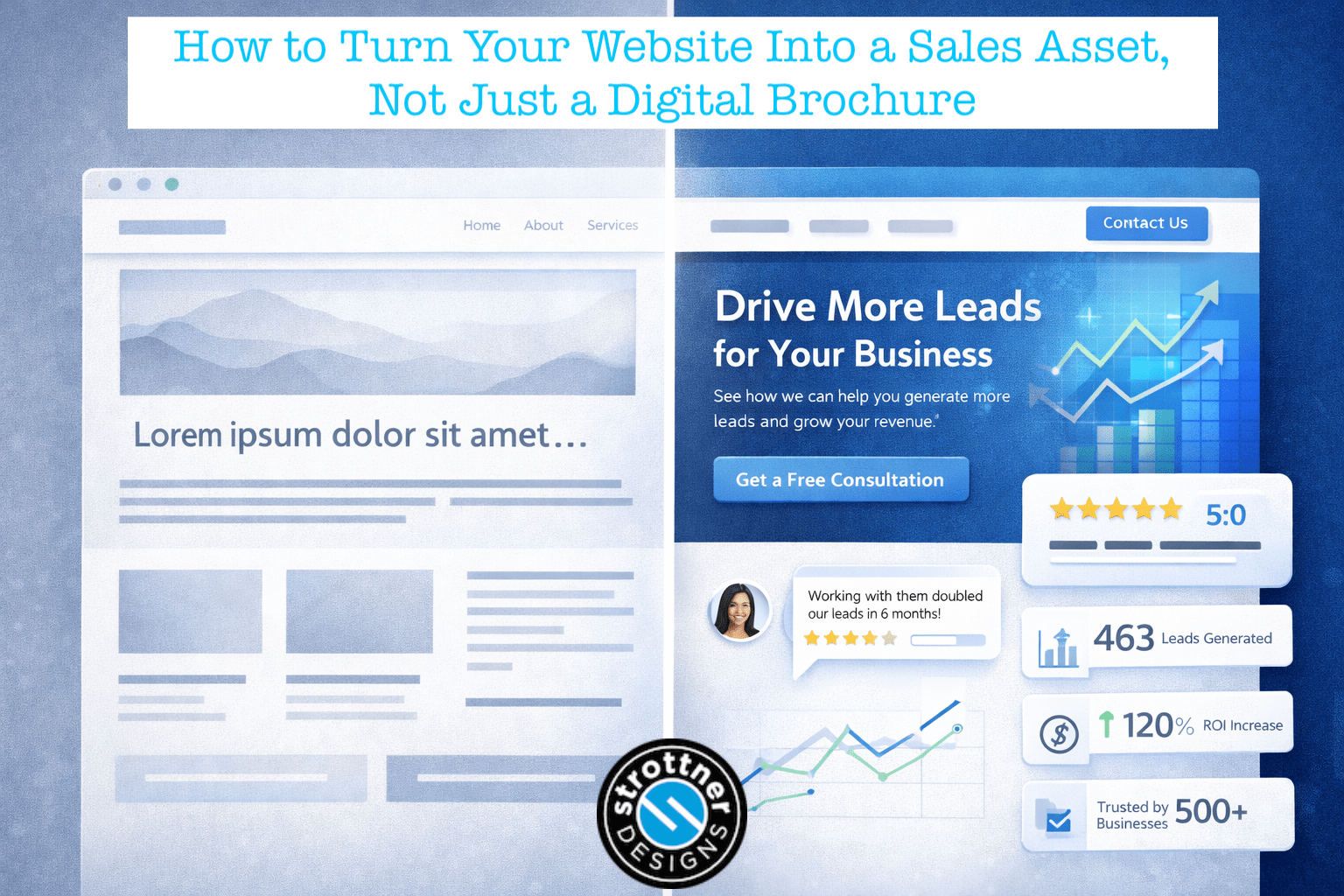
A strategic website today isn’t a brochure. It’s infrastructure.
It should:
It’s built intentionally around business goals, not aesthetics alone.
That means aligning:
Good enough websites weren’t built with this alignment.
Search is evolving quickly.
AI-powered search results prioritize:
Businesses that publish authoritative, clearly structured content across related topics are more likely to surface in AI-generated summaries.
That visibility builds credibility before a user ever clicks.
If your site lacks structure, clarity, and depth, it won’t appear in these emerging search experiences.
That’s not hypothetical. It’s already happening.
When a website is rebuilt strategically, improvements stack.
Organic traffic grows.
Conversion rates improve.
Paid ad efficiency increases.
Brand authority strengthens.
Marketing becomes more predictable.
Momentum builds.
That’s the difference between an expense and an investment.
If your website disappeared tomorrow, how much revenue would vanish with it?
If the answer is “not much,” that’s not a sign of safety. It’s a sign of underperformance.
Your website should be a core growth asset.
If it isn’t, something’s misaligned.
At Strottner Designs, we don’t start with colors or layouts. We start with alignment.
We look at your:
Then we build infrastructure around measurable outcomes.
At Strottner Designs, design for clarity, search visibility, authority, and performance. We structure content to support both traditional SEO and AI discovery. We align messaging with real buyer intent. And we build beautiful websites that get the prospective client to contact you as quickly as possible.
Most organizations can’t see their own blind spots clearly. They’re too close to the problem.
We bring perspective, structure, and strategy.
A website shouldn’t just look better. It should perform better.
If you’ve been thinking about updating your website for months, you don’t need convincing.
You already feel it.
It doesn’t fully represent who you are now.
It doesn’t generate what it should.
It doesn’t support the growth you’re aiming for.
The question isn’t whether it’s “good enough.”
The question is whether you’re ready to stop absorbing the hidden cost.
Strategic companies don’t settle. They build assets that support their next level of growth.
Your website should be one of them. Contact us today so that we can make your website better than “good enough.”

Interested in a new site and SEO, or just a new site? Visit Home of the Free Website to learn how we can build you a free or affordable site.

Privacy Policy | Sitemap | Terms of Use