
Most business websites are not broken.
They load. They have pages. There’s a contact form somewhere. Maybe even a blog.
From a distance, they look fine.
Up close, they’re leaking revenue.
After reviewing hundreds of business sites, we continue to see the same common website mistakes appear again and again. They aren’t dramatic failures. They’re subtle. Quiet. Easy to overlook.
And surprisingly expensive.
If you run a business, manage marketing, or lead growth strategy, we’re here to help you identify the most common website mistakes and understand exactly why they cost more than most companies realize.
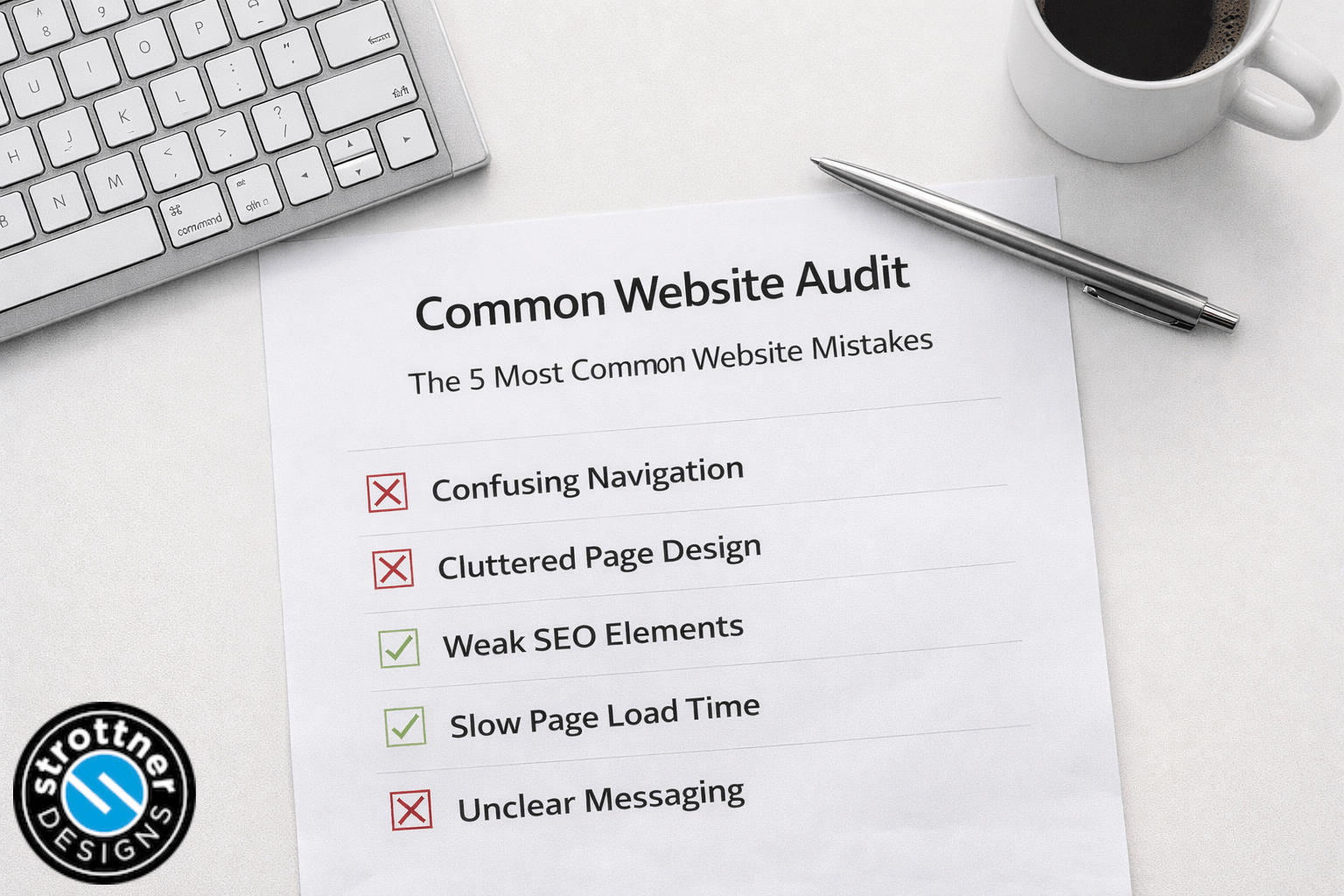
The most common website mistakes businesses make include:
Individually, these issues may seem minor. Together, they compound into lost traffic, lower conversion rates, weaker authority, and missed revenue.
Let’s break them down.
There’s nothing wrong with those statements.
They’re just not what your visitor is thinking.
When someone lands on your website, they’re asking:
If your homepage reads like a corporate biography instead of a customer-focused solution, attention drops quickly.
Messaging affects conversion rates directly.
When visitors do not see their problem clearly reflected, they hesitate. Hesitation reduces inquiries. Reduced inquiries lower revenue.
Even small clarity improvements can dramatically increase lead generation.
This is one of the most common website mistakes because it feels harmless. It is not.
Effective messaging:
Instead of “We are a full-service firm,” try:
“We help growing businesses increase qualified leads through strategic website optimization.”
Specific. Outcome-focused. Clear.
Clarity converts.
Many companies believe they are “doing SEO” because they’ve added keywords to titles or written occasional blog posts.
That’s not enough.
Search intent answers a simple question:
What is the user actually trying to accomplish?
If someone searches “how long does SEO take,” they want a realistic timeline. If your page gives vague marketing language instead of a direct answer, it will struggle to rank.
Search engines reward clarity and usefulness.
Businesses often create content based on what they want to say, not what users want to find.
When content misses search intent:
Organic visibility compounds. So does invisibility.
Strong SEO alignment includes:
Modern SEO is not about keywords alone. It is about intent.
Speed and technical health are foundational.
Common issues include:
The website may still “work.” That does not mean it performs well.
Technical performance affects:
Slow websites frustrate users. Frustrated users leave. High bounce rates send negative signals to search engines.
This is one of the most common website mistakes because it is invisible until it causes measurable damage.
Technical optimization is not glamorous. It is profitable.
Your website exists to move users forward.
Yet many sites rely on generic calls to action:
These are functional. They are not persuasive.
When calls to action lack specificity:
Traffic without action is wasted opportunity.
This mistake is especially costly when businesses are investing in paid ads. If conversion rates are weak, every click becomes more expensive.
Strong calls to action:
Examples:
Specificity improves performance.
Ambiguity limits it.
This may be the most financially damaging mistake of all.
A company launches a website. There’s excitement. Traffic improves slightly.
Then nothing changes for years.
No structured content growth.
No strategic updates.
No performance reviews.
The website becomes static.
Search engines reward consistency.
Competitors publishing structured content monthly build:
A static website slowly declines in relevance.
This is one of the most common website mistakes because it feels comfortable. But comfort is not strategy.
Websites are infrastructure. Infrastructure requires maintenance.
None of these mistakes seem catastrophic individually.
That is what makes them dangerous.
Unclear messaging reduces conversions by 20 percent.
Slow load speed increases bounce rate by 15 percent.
Weak SEO alignment limits traffic growth by 30 percent.
Stack those together.
Over time, the revenue impact becomes significant.
Most businesses never calculate this compound cost.
They only notice when growth plateaus.
Search is evolving.
AI-driven search tools prioritize:
Websites that commit common website mistakes like vague structure and thin content are less likely to appear in AI-generated summaries.
Visibility is no longer limited to traditional rankings.
Structure and clarity are competitive advantages.
To recap, the most common website mistakes businesses make are:
Each of these reduces traffic, conversions, authority, or growth potential.
Together, they quietly limit performance.
High-performing business websites are not accidental.
They are:
They function as growth engines, not digital brochures.
At Strottner Designs, we approach websites as long-term assets. We align messaging, search strategy, technical performance, and conversion psychology around measurable outcomes.
Most businesses do not see these common website mistakes until performance stalls.
By then, competitors have already gained ground.
If your website quietly improved conversions by 25 percent and organic traffic by 40 percent, would that matter?
Of course it would.
The most expensive website mistakes are rarely dramatic. They’re subtle. Persistent. Compounding. And over time, they quietly limit growth.
The good news is that these problems are fixable.
If you suspect your website may be underperforming, it’s worth getting clarity before investing in more ads, more content, or more marketing tools. The foundation matters.
If you’re ready to stop settling for “good enough,” let’s talk. Your website should support your next level of growth, not hold it back.

Interested in a new site and SEO, or just a new site? Visit Home of the Free Website to learn how we can build you a free or affordable site.

Privacy Policy | Sitemap | Terms of Use