
Every January, business owners and marketing teams dust off their dashboards, glance at last year’s numbers, and land on the same conclusion:
“We need more traffic.”
More visitors. More clicks. More impressions. More activity.
It feels like progress. Charts go up. Reports look busy. Everyone nods in approval.
But here’s the problem. Traffic by itself doesn’t grow a business. It doesn’t book appointments, sign retainers, or close deals. In many cases, it just creates more noise.
After years working with business owners, doctors, attorneys, and growing companies at Strottner Designs, we’ve seen this pattern repeat itself again and again. Teams chase traffic because it’s easy to measure, not because it’s effective.
The new year is the perfect time to reset that thinking.
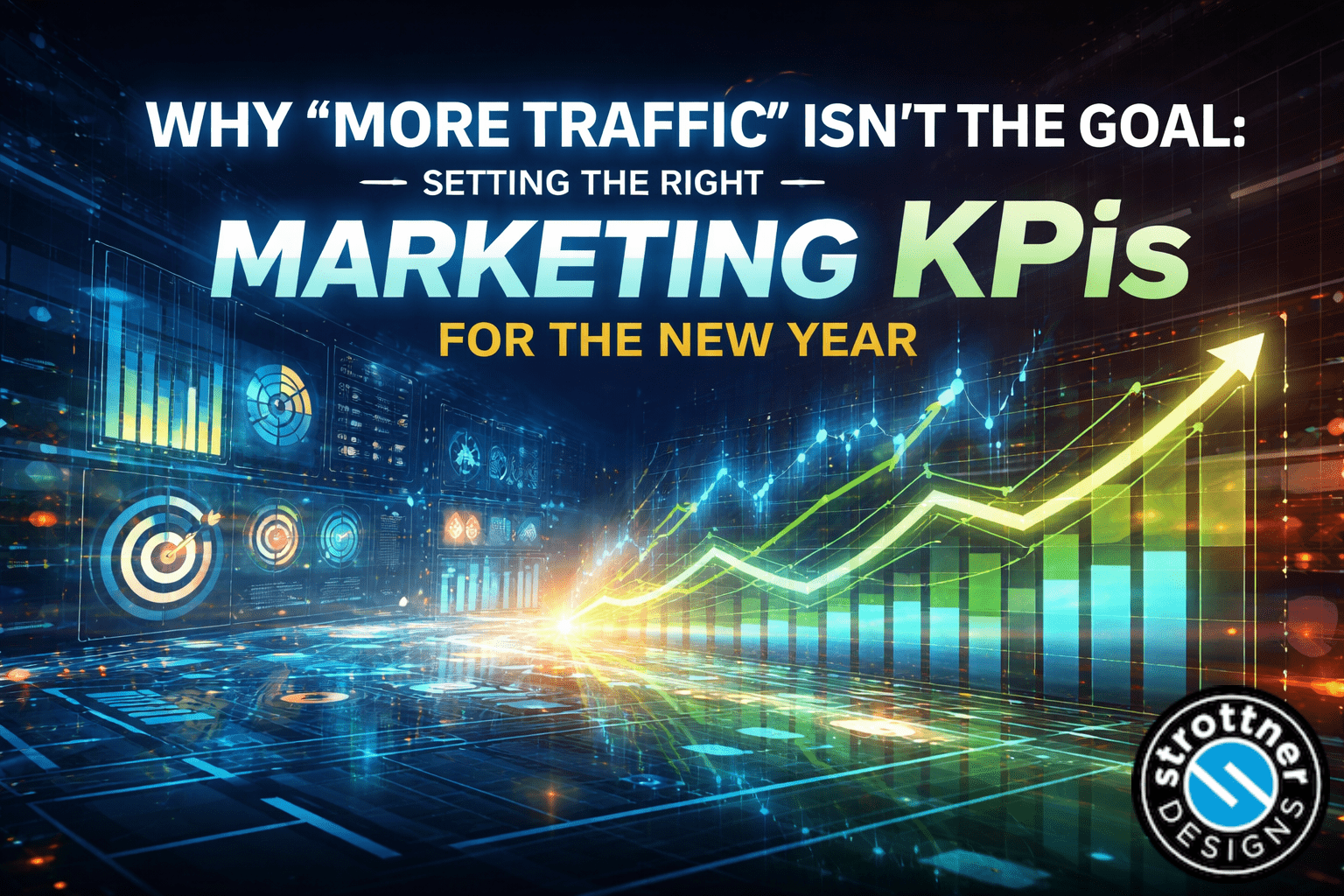
This article isn’t about getting louder. It’s about getting smarter. We’ll break down why “more traffic” is the wrong goal, which marketing KPIs actually matter, and how to set measurements that support real business outcomes instead of vanity metrics.
Imagine you own a high-end jewelry store.
One day, the mall announces record-breaking foot traffic. Thousands of people stream past your storefront. Teenagers. Joggers. People killing time before a movie.
But almost no one walks into your store.
And the ones who do ask where the bathroom is.
Would you call that a successful day?
Of course not.
Website traffic works the same way. Raw traffic numbers tell you how many people passed by. They don’t tell you:
Yet every year, businesses set traffic goals as if more passersby automatically equals more sales.
It doesn’t.
Traffic became popular as a KPI for three reasons.
Analytics tools make traffic obvious and accessible. You don’t need a strategy meeting to understand “last month vs. this month.”
When numbers go up, it feels like winning. Even if nothing else changes.
Saying “we need more traffic” sounds proactive without requiring hard decisions about positioning, messaging, or conversion.
But easy doesn’t mean effective.
Here’s what happens when traffic becomes the primary goal.
If your KPI is traffic, the fastest way to increase it is to broaden your net. That usually means generic content, watered-down messaging, or trendy topics unrelated to your actual offer.
You’ll get visitors.
They just won’t convert.
Many businesses pour money into ads and content without fixing obvious problems:
More traffic just means more people hitting the same roadblocks.
Traffic looks good in reports. It does not pay salaries.
Sales, leads, booked consultations, retained clients. Those are what keep the lights on.
Instead of asking how to get more traffic, ask this:
“What action do we want the right visitor to take?”
That one question changes everything.
It forces you to think about:
And that’s where real KPIs come from.
KPI stands for Key Performance Indicator. The key part matters.
A KPI is not:
A KPI is a signal that tells you whether marketing is supporting business goals.
If the metric doesn’t influence decisions or revenue, it’s not a KPI. It’s trivia.
Before setting marketing KPIs, step away from tactics.
Forget SEO. Forget social media. Forget ads for a moment.
Ask:
A law firm, a medical practice, and a SaaS startup may all want “growth,” but growth means different things in each case.
Marketing KPIs should map directly to that outcome.
Let’s talk about metrics that actually deserve attention.
Not leads. Qualified leads.
A contact form submission from someone who can’t afford your services is noise. A booked consultation with a decision-maker is signal.
Track:
If traffic goes down but qualified leads go up, marketing is working.
Conversion rate answers a powerful question:
When the right person shows up, do they take action?
You can double revenue without increasing traffic by improving:
Conversion rate optimization is less glamorous than traffic growth, but far more profitable.
CPA keeps marketing honest.
If it costs you $5,000 to acquire a $3,000 client, traffic volume doesn’t matter. You’re scaling losses.
Good KPIs force you to measure efficiency, not just activity.
Marketing doesn’t have to “close” deals to be valuable.
Track:
This shifts the conversation from “marketing is busy” to “marketing is contributing.”
This is where mature businesses focus.
If one client stays for five years and refers others, that traffic source is far more valuable than one that produces one-time buyers.
KPIs tied to LTV encourage smarter, long-term decisions instead of short-term spikes.
Traffic isn’t useless. It’s just misunderstood.
Traffic is a diagnostic metric, not a goal.
It helps you:
But it should always be read alongside intent and behavior.
Think of traffic like blood pressure. Useful to monitor. Dangerous to obsess over without context.
More traffic doesn’t help if patients can’t find:
Better KPIs: appointment requests, show rates, patient retention.
Ranking for broad legal terms brings tire-kickers and DIY researchers.
Better KPIs: consultation requests for specific case types, cost per signed client.
High traffic content often attracts students and competitors.
Better KPIs: demo requests, sales-qualified leads, deal velocity.
Different industries. Same lesson.
As you head into the new year, ask yourself:
If the answers are fuzzy, your KPIs need a reset.
Traffic-first KPIs are comfortable. Outcome-based KPIs are accountable.
They require alignment between:
They force uncomfortable conversations about what’s actually working.
But they also create clarity, focus, and momentum.
At Strottner Designs, the most successful clients we work with aren’t chasing volume. They’re refining precision.
More traffic feels like growth.
Better KPIs are growth.
This year, don’t aim for louder marketing. Aim for smarter marketing.
Measure what moves the business, not what fills a chart.
Because at the end of the day, traffic doesn’t buy.
People do.
And only the right people, taking the right actions, at the right time, will move your business forward.
If that’s your goal for the new year, you’re already asking better questions than most. Contact us today, and we’ll help you with your answers.

Interested in a new site and SEO, or just a new site? Visit Home of the Free Website to learn how we can build you a free or affordable site.

Privacy Policy | Sitemap | Terms of Use