
 Is your website ready for 2026?
Not “does it technically exist.”
Not “does it look okay.”
Not “did we redo it a few years ago.”
Ready.
Because readiness in 2026 has nothing to do with trends and everything to do with performance, trust, and momentum.
Your website is no longer a passive asset. It’s not a brochure, not a portfolio, and it’s not a box to check so you can focus on “real business.”
It is real business.
In many industries, your website is now:
And most websites don’t fail loudly.
They explain things a little too vaguely.
They make visitors think a little too hard.
And opportunity slips away without anyone noticing.
This guide is designed to help you answer one question honestly and without hype:
Is your website ready for 2026, or is it already behind?
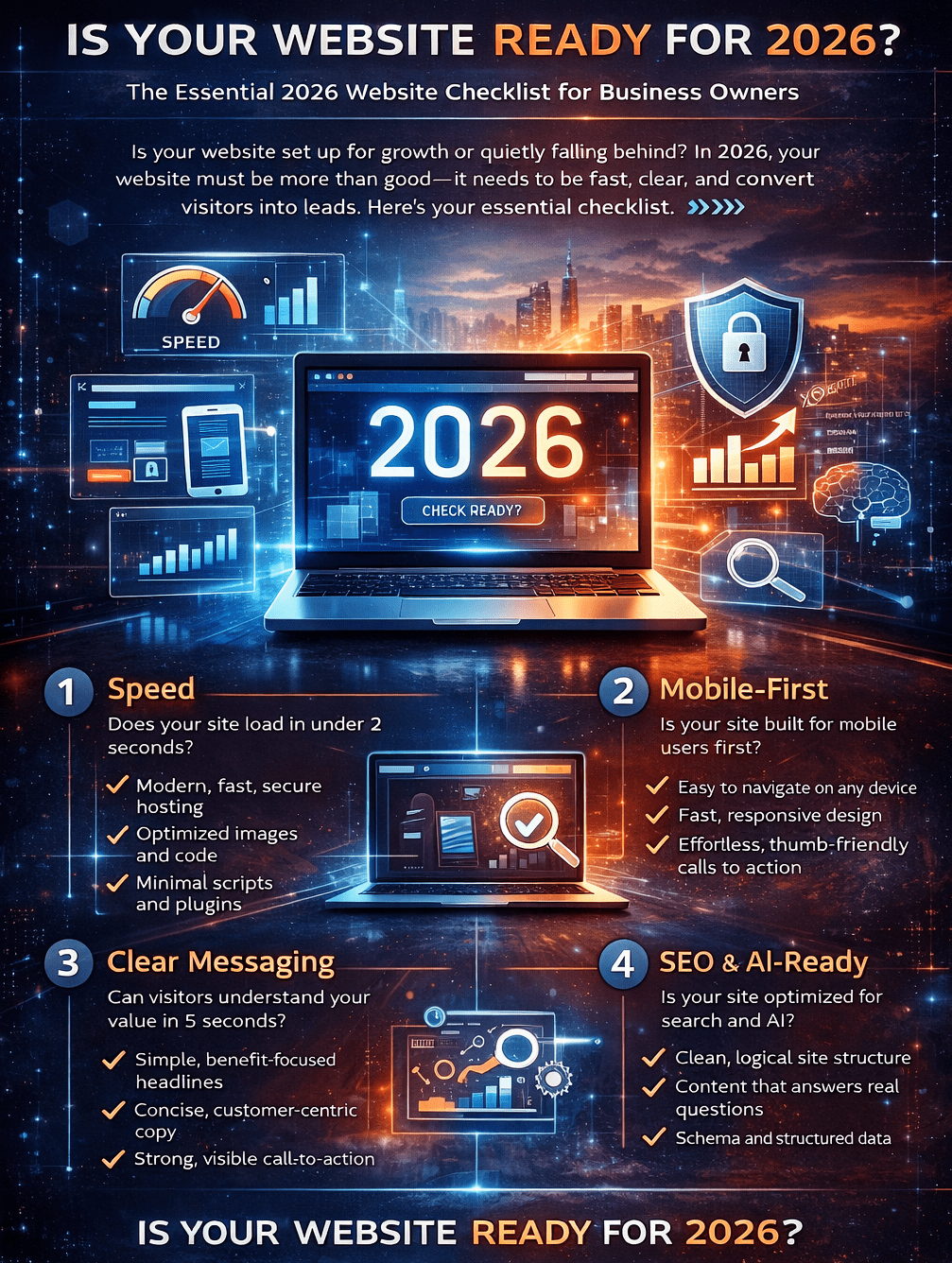
A website ready for 2026 is not trendy. It’s disciplined.
It does five things consistently well:
If any one of those breaks down, the whole system weakens.
Let’s break this down in detail.
Speed is invisible when it works and devastating when it doesn’t.
When someone wonders, “Is your website ready for 2026?” speed is the first thing they experience, whether they’re conscious of it or not.
A slow website signals:
By 2026, users expect near-instant access everywhere online. That expectation does not stop when they land on your site.
A 2026-ready website:
We often see businesses invest heavily in branding and design, only to undermine it with slow performance. Speed is not a technical checkbox. It’s a trust signal.
If your site feels slow to you, it feels broken to your prospects.
If your website was designed desktop-first and “adapted” for mobile, it’s already behind.
In 2026, most first impressions happen on a phone. That includes executives, decision-makers, and buyers with budgets.
A website that’s ready for 2026 on mobile:
Mobile usability isn’t about convenience anymore. It’s about credibility.
If someone struggles to use your site on their phone, they won’t “try again later.” They’ll move on.
This is where most websites quietly fail.
They look professional.
They sound polished.
And they say almost nothing.
A website ready for 2026 answers four questions immediately:
If a visitor has to scroll, guess, or interpret clever language, you’ve lost them.
Strong 2026 messaging is:
If someone skims your homepage and can’t explain your business back to you, the messaging is not doing its job.
Adding a “Contact Us” button does not make your website convert.
Conversion happens when your site builds confidence step by step.
A website ready for 2026 understands intent.
Some visitors are ready to talk.
Others need proof.
Others need education.
Your site should support all of them.
That means:
Conversion is not pressure. It’s guidance.
Your website should feel like a helpful conversation, not a sales ambush.
Search is no longer just people typing keywords into a box.
It’s voice search.
AI summaries.
Recommendation engines.
Zero-click results.
A website ready for 2026 is structured so both humans and machines understand it.
That includes:
SEO today is less about tricks and more about clarity.
The easier your website is to interpret, the more visible it becomes across every discovery channel.
Content is no longer optional if your website is going to be ready for 2026.
But most content doesn’t help sales. It fills space.
Effective content:
Your sales team should be able to say, “Read this,” and know it strengthens the conversation.
If content doesn’t reduce uncertainty, it isn’t doing its job.
People are skeptical. For good reason.
Your website has to earn trust quickly.
A 2026-ready website uses proof, not hype:
Design supports trust. Proof creates it.
Businesses that show evidence consistently outperform those that rely on polished language alone.
By 2026, these are not “nice to have.”
They are expectations.
A readiness foundation includes:
Visitors may not articulate what’s missing, but they feel it when something is off.
Professional businesses get this right.
A website ready for 2026 pre-sells your value.
Before someone reaches out, they should already understand:
That means:
When this is done well, sales conversations start at a higher level and close faster.
If you’re not measuring behavior, you’re guessing.
A website ready for 2026 tracks:
Data shows you what’s working, what’s broken, and where to invest next.
Instinct matters. Insight scales.
So, is your website ready for 2026?
If it’s:
Then no. It’s not.
And that’s not a failure. It’s a signal.
Websites don’t become strong digital foundations by accident. They’re built intentionally.
In 2026, your website will either:
Or it will quietly push opportunities toward competitors who took readiness seriously.
At Strottner Designs, we help business owners answer the readiness question honestly and fix what’s holding them back. Contact us today, and we’ll make sure you have all the right answers to, “Is your website ready for 2026?”
Because the businesses that win in 2026 won’t be louder.
They’ll be prepared.

Interested in a new site and SEO, or just a new site? Visit Home of the Free Website to learn how we can build you a free or affordable site.

Privacy Policy | Sitemap | Terms of Use