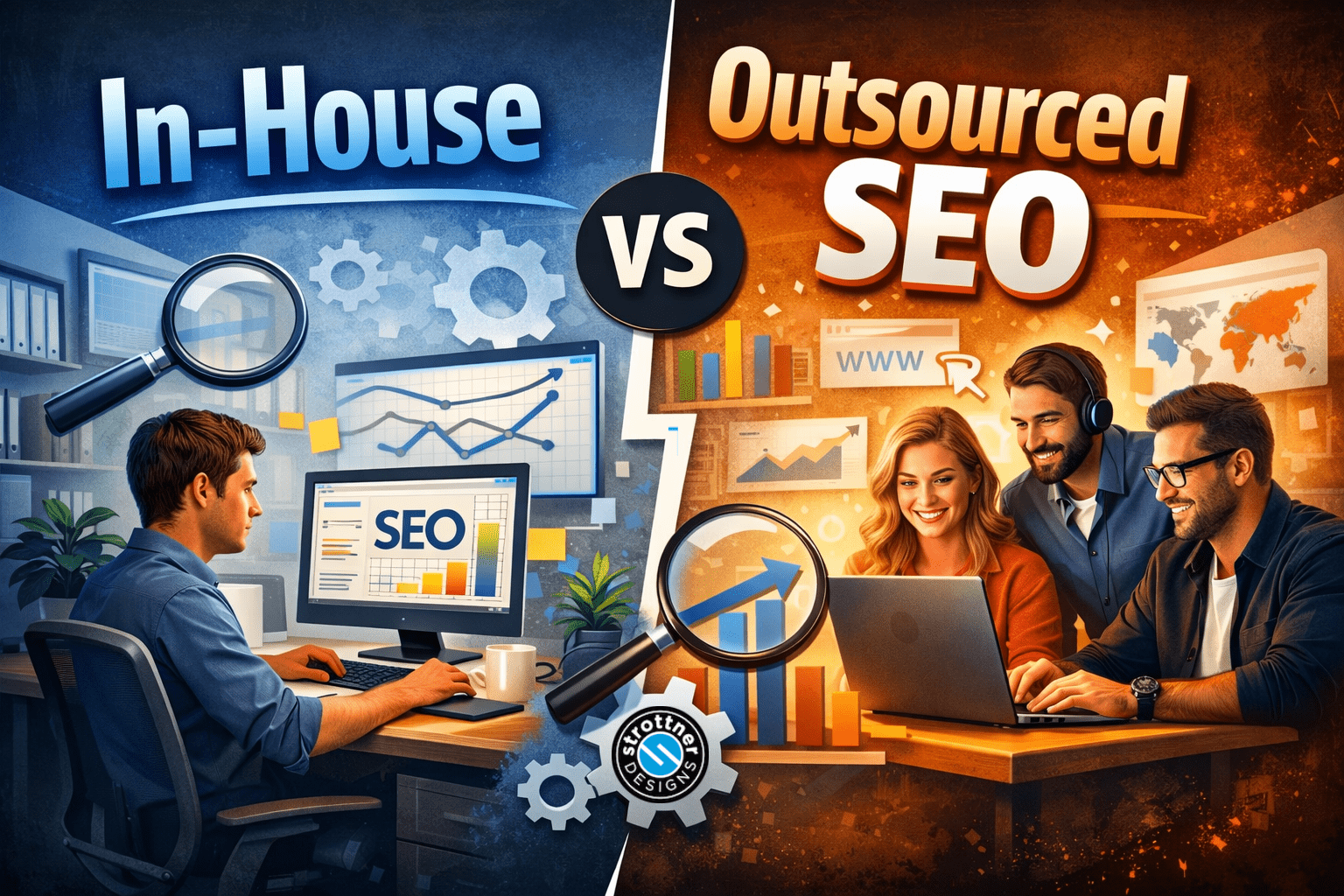
In 2026, SEO is still king for getting your website noticed,about 47% of all site visits come from organic search. But for U.S. small businesses with tight budgets and lean teams, the big question is: do you build your own in-house SEO team, or hire an outside agency? It’s a bit like deciding whether to cook a gourmet meal at home (full control, more effort) or dine at a bustling restaurant (expert chefs, but you pay per meal). Let’s weigh the pros and cons of in-house vs. outsourced SEO, explore the latest SEO trends shaping the landscape, and even include a handy decision “flowchart” to help you choose. Along the way, we’ll show how Strottner Designs’ full-service SEO, web design, branding, and content services can fit your small business’s needs.
Why SEO Still Matters for Small Businesses
First, why should a small business care about SEO in 2026? Simply put, organic search drives nearly half of web traffic. In fact, when done well, SEO can deliver hundreds of percent ROI over time. Modern SEO isn’t about keyword stuffing or quick hacks; it’s about building a strong web presence and reputation. Customers increasingly find businesses via Google, voice assistants, and even AI-chat platforms, so investing in SEO means more visibility, foot traffic, and leads. If your café in San Antonio or your boutique in Austin isn’t showing up on page one, you’re leaving business on the table. The question isn’t if you need SEO, but how you handle it, in-house or outsourced.
Before deciding, let’s clarify: in-house SEO means using your own staff (or hiring employees) to handle everything, keyword research, content writing, technical fixes, link-building, etc. Outsourced SEO means partnering with an agency or freelancers who specialize in SEO. Both paths can work, but each has distinct tradeoffs for small businesses.
In-House SEO: Pros and Cons
Hiring an in-house SEO person (or team) can feel comfortable, it’s like training your own pit crew for a race. Your team lives with the brand day in and day out, so they deeply understand your products, customers, and culture. They can quickly adapt messaging and changes, and maintain tight alignment with your business goals. An in-house SEO resource can make instant website updates or tweak a title tag on the fly. This full control is a big pro: changes can be faster and more integrated with your overall marketing. Plus, over years a dedicated team builds institutional knowledge and brand authenticity. Think of them as a long-term asset who “lives” your brand.
Pros of In-House SEO:
- Total Control & Brand Alignment: Your in-house team has 100% focus on your brand’s voice and priorities. They work right alongside your content writers, designers, and sales staff, creating a tightly integrated strategy.
- Full-Time Availability: They’re on your payroll, so they can pivot quickly when campaigns or algorithms change. “Our SEO changes tomorrow? No problem,” says the marketer.
- Deep Audience Insight: Since they breathe your business every day, they often spot niche keywords or local trends others would miss. (For example, they know the quirks of San Antonio’s market firsthand…hello, chicken on a stick!)
However, in-house SEO has downsides, especially for small businesses. The cost is hefty: hiring just one SEO specialist in the U.S. can mean a $60K–$120K salary plus benefits, training, and office space. Don’t forget the software bills, SEO tools like Ahrefs, SEMrush, or Moz can cost thousands per year. Building even a small team means multiplying those costs. In fact, salaries, tools, equipment, and even the risk of a bad hire can all balloon your budget.
Additionally, an in-house person often ends up wearing many hats. SEO isn’t one single job; it’s content strategy, technical fixes, link outreach, analytics, and more. A tiny in-house team may be a “jack of all trades” who juggles too many tasks. This can actually slow down progress: with just one or two people on your SEO, the strategy can only move as fast as they can multitask. They might prioritize only a few tasks, pushing others off for weeks. It’s like having one chef in the kitchen trying to bake the bread, grill the steak, and plate the desserts all at once, things get delayed or undercooked.
Cons of In-House SEO:
- High Overhead: Beyond salary, you must pay for benefits, office space, and SEO tools. These fixed costs can strain a small business budget (often $8K–$15K+/month for a small team).
- Slow Ramp-Up: Recruiting and training an SEO expert takes time, typically 6–12 months to hire and get results. Meanwhile, competitors don’t wait.
- Limited Expertise: No single person can master every aspect of SEO and the latest 2026 trends (AI tools, voice, GEO-targeting, etc.). You may still need to outsource some tasks (like coding or complex analytics) even with in-house help.
- Risk of Turnover: Talented marketers move fast; losing your SEO hire can set you back a ton.
In short, in-house SEO gives you control and unity with your brand, but it demands significant resources and commitment. It’s ideal if your small business is ready to invest long-term (and if marketing is a core competency of yours). If not, it’s worth considering an external partner.
Outsourced SEO: Pros and Cons
Outsourcing SEO is like hiring a team of specialist builders for your home renovation. You get experienced pros for as long as you need them, without buying all the tools and materials yourself. SEO agencies (or consultants) bring collective expertise, keyword researchers, content writers, link-builders, and tech geeks, all under one roof. You essentially pay a service fee, not a full salary and office overhead. This often makes outsourcing more cost-effective for small businesses. One report notes that companies save roughly 30–70% by outsourcing SEO versus keeping it in-house. (That’s money you can reallocate to ads, inventory, or growth initiatives.)
Pros of Outsourced SEO:
- Access to Expertise: A good agency comes with a whole team of specialists. Instead of one generalist, you get separate experts for on-page SEO, technical SEO, content marketing, local SEO, and more. They’ve “seen it all” across industries, so they know what works and what doesn’t.
- Pay for Results, Not Overhead: You only pay for the services rendered (monthly retainer, project fee, etc.), not full-time salaries. The agency handles its own hiring, training, and tool subscriptions. This lean model is usually lighter on your budget.
- Faster Turnaround: Established agencies have processes and staff ready, so they can hit the ground running. Deliverables and improvements often arrive quicker than if you built a solo in-house team. For example, an agency can publish content and fix technical issues in parallel, whereas one in-house hire might do them sequentially.
- Scalability: Growing or pausing marketing efforts is easy. Need more work done this month? The agency just allocates more team-hours. Lean month? You scale down without awkward layoffs or idle staff. Many outsourced teams even work across time zones, so progress can happen “overnight” while you sleep.
- Latest Tools and Training: Agencies often invest in premium SEO tools and continuous education. Your small biz benefits from that cutting-edge tech without you paying extra for subscriptions or courses.
Despite the advantages, outsourcing isn’t a magic bullet. Handing your online strategy to an outside team means less direct control day-to-day. You’ll need to establish good communication and trust. Some agencies prefer to deliver polished results without walking you through every detail, which can feel opaque. It’s crucial to choose a transparent, results-driven partner. Look for an agency that shares reports and explains how they achieve SEO gains.
Cons of Outsourced SEO:
- Less Control: You won’t be able to lean over the shoulder of the SEO pro every day. Meetings and reports are the main touchpoints, so it’s not as instant as an in-house tweak. You’ll need patience and clear communication.
- Finding a Good Partner: Not all agencies are equal. Some red flags: agencies with no client history, unrealistic guarantees, or poor own rankings. A tiny team or freelancer can also be risky – if they’re unavailable, poof, your SEO dries up.
- Alignment Challenges: An outside team needs time to learn your brand, audience, and processes. Initially they may pitch generic content ideas until they absorb your niche. (A savvy SEO agency like Strottner Designs accelerates this with a thorough onboarding process.)
- Ongoing Cost: You pay month after month. If you ever stop paying, the work stops (unlike in-house knowledge that stays). However, savvy agencies are worth it: many small businesses recoup the agency fee through increased leads and sales.
Ultimately, outsourcing trades some daily control for breadth of skill and convenience. For many small businesses, it’s a smart move: you avoid hiring headaches, pay-as-you-go, and tap a full suite of capabilities. An agency can quickly incorporate the latest SEO techniques (which can be a full-time job to track if you’re small).
SEO Trends to Watch in 2026
Whether in-house or outsourced, your SEO strategy must ride the waves of 2026’s trends. Today’s search engines are powered by AI and user intent, not just keywords. Here are the big shifts transforming SEO for small businesses:
- AI-Driven Search & Structured Data: Search engines now act more like intelligent assistants. Google and others use AI models that handle discovery, decisioning, and even transactions. In practice, this means your content should be machine-friendly. Use clean site structure and Schema markup so AI “agents” can parse your info. (brands need to prepare with structured, machine-readable content for this new era.) Google’s new AI Overviews are replacing old featured snippets, and chat-based tools (ChatGPT, etc.) are becoming new “search engines.” To win, focus on helpful, in-depth content that answers real user questions – not on gaming any algorithm.
- Voice Search and Local Optimization: More customers use voice assistants for local queries (“Where’s the best taco shop near me?”). Already ~30% of searches are voice-based and rising, with predictions of 50% by 2025. Even more telling: roughly 70% of voice-search users have found local businesses via their smart devices. This trend makes local SEO and conversational content crucial. Small businesses must optimize their Google Business Profile, use natural long-tail phrases, and answer “near me” questions. Encouraging customer reviews also boosts local presence, since voice assistants often read out top-reviewed shops.
- Video and Visual Content: Video rules the Internet. Cisco predicted that by 2026, video will make up over 80% of online traffic. Platforms like YouTube and TikTok are becoming major discovery channels (think “best hiking trails #shorts” instead of text). Small businesses should incorporate videos – tutorials, product demos, brand stories – into their SEO strategy. Videos increase engagement, time-on-site, and backlinks (all positive SEO signals). Even on-page, embedding relevant videos can reduce bounce rates. (Pro tip: have transcripts and descriptions to help Google index your videos too.)
- Mobile-First Experience: By 2026 Google’s shift to mobile-first indexing is complete. In other words, Google predominantly uses the mobile version of your site to rank and index. If your site isn’t optimized for mobile, you’ll lose ground. Make sure your website is responsive, loads fast on phones, and offers a great user experience (simple navigation, legible text, etc.). Page experience metrics – like loading speed, interactivity, and visual stability – are now ranking factors. For example, a travel agency saw higher rankings and bookings when they revamped their mobile site to load quickly and include interactive maps. Strottner’s web design team emphasizes these “mobile-first” best practices, since a smooth mobile site boosts both user satisfaction and SEO.
- Content Quality & E-E-A-T: Search engines reward expertise and trust. In 2026 the adage is: unique, human-crafted content wins. AI can write blog posts, but users and Google’s helpful-content update favor human insight, authority, and authenticity. Google’s E-E-A-T (Experience, Expertise, Authoritativeness, Trust) concept is at full throttle: sites that build real brand credibility – through author bios, case studies, social proof, and transparent communication – will outrank faceless content mills. In practice, this means your small business should highlight its unique story: owner experience, local community involvement, customer testimonials, etc. Strottner Designs can help craft that original content and branding that sets you apart.
- Personalization & Privacy: Users now expect search results tailored to them – location, device, and behavior all factor in. Analytics and machine learning tools allow SEO teams to fine-tune content for different segments. At the same time, privacy regulations (GDPR, CCPA) matter. Small businesses must balance collecting user data with keeping visitors’ trust. Using opt-in analytics and providing a privacy-forward site (clear cookie policies, fast opt-outs) is good practice. We incorporate transparent privacy messaging and consent banners by default, so your SEO strategy stays both effective and compliant.
Each of these trends shifts how you optimize. The bottom line: focus on people (and AI helpers) over tricks. Create mobile-friendly, video-rich, conversational content that answers questions sincerely, and your SEO will thrive in 2026.
Key Factors and a Decision Flowchart
With the pros/cons and trends in mind, how do you decide which approach fits your business? Consider these critical factors:
- Budget and ROI: Crunch the numbers. An in-house hire means fixed costs (salary, benefits, tools), whereas an agency lets you pay monthly for specific deliverables. A small in-house team can cost $8K–$15K per month, while outsourcing similar work might run $2K–$6K. Outsourcing often saves 30–70%, money you could put toward social ads or new equipment. On the flip side, in-house SEO can pay off long-term if your business has the capital and high volume of work. Consider how quickly you need results too: agencies typically show improvements faster, which accelerates ROI.
- Available Expertise: Do you (or your team) already have SEO skills? If you have a savvy web developer or marketer who “gets” search, an in-house solution might leverage that. If not, you’ll spend months hiring and training. Agencies come pre-loaded with experts. For example, according to marketing professionals, algorithm updates happen hundreds of times a year. An in-house generalist can’t chase all that alone, but an agency’s dedicated team will stay current and build strategies around changes.
- Control vs. Convenience: How much hands-on control do you want? An in-house person is part of your everyday workflow; you can adjust priorities instantly. Outsourcing asks you to trust an outside team to run with it. Some businesses prefer the full visibility of in-house; others value handing the baton to an expert. Remember: good agencies (coughStrottnercough) will walk you through their process.
- Scalability: Does your business have seasonal needs or growth spurts? Agencies excel at scaling. Need a big push for the holidays? They can allocate more resources immediately. Just launched a small side project? Scale down without firing anyone. An in-house team is less flexible – scaling means hiring or overloading employees. One client story: a small biz started with an in-house SEO hire, then had to post on job boards and waste months training her replacement when they wanted to expand. Outsourcing avoids that rollercoaster.
- Service Scope: SEO doesn’t exist in a vacuum. Do you also need new website design, branding refresh, or social media support? Here outsourced agencies (and especially Strottner Designs) can shine. We’re a full-service shop – we do web design, branding, graphic design, content, social media and of course SEO. That means we handle your site’s UX, brand voice, and technical SEO all at once. If you try to do SEO entirely in-house, you’d still end up outsourcing design or content to experts. With us, everything’s integrated: for example, our designers make SEO-friendly sites from the ground up, and our copywriters craft keyword-rich content that matches your brand voice.
- Time and Resources: Outsourcing frees you to focus on your core business. Instead of learning HTML and crawling reports, spend time closing sales or serving clients. On the other hand, if you enjoy the marketing grind or have internal capacity, in-house might be fulfilling. Think of Strottner as an extension of your team: we handle the tedious stuff (technical audits, link outreach, content schedules) so you can focus on running your business.
To help visualize this decision, consider the chart below. Small companies usually have fewer resources but more flexibility, while larger organizations have deeper pockets but move more slowly. Your situation probably falls somewhere on this spectrum.
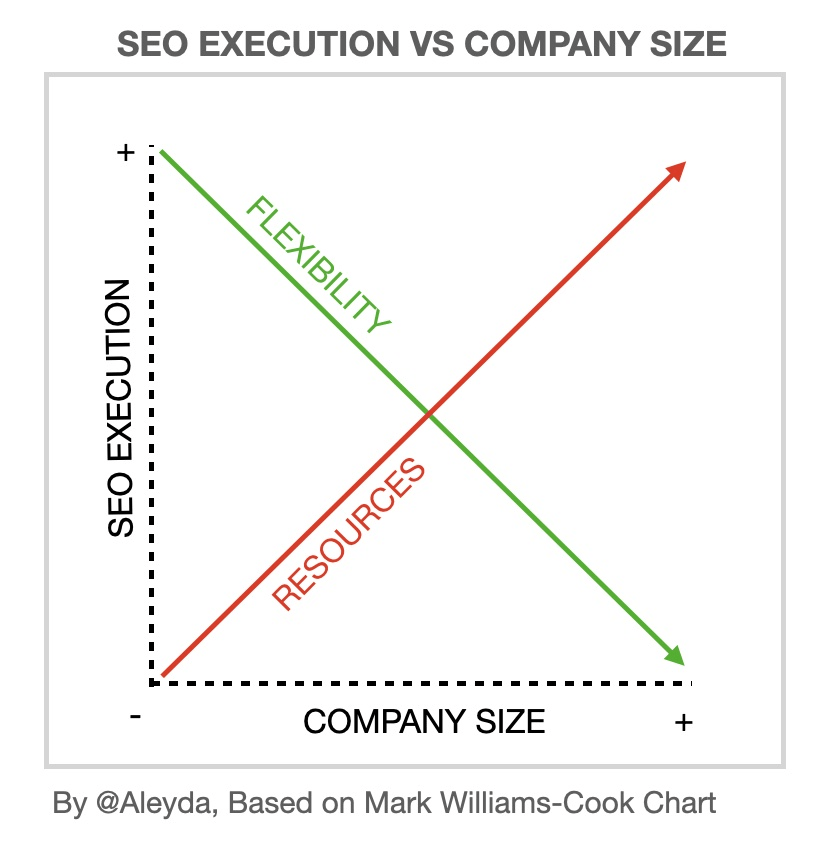
Figure: Smaller companies tend to have limited resources but high flexibility, whereas larger firms have more resources but move less nimbly. Based on where you sit:
- If you’re a very small business (few staff, tight budget), outsourcing might make sense because it brings expert horsepower without the full-time cost.
- If you have an existing marketing team (even a one-person marketing department), ask whether they can realistically add SEO duties on top of everything. If they’re already stretched thin, an agency can supplement or train them.
- If you love data and hands-on marketing, maybe hire an SEO specialist (or let us train your team). But if you’d rather view SEO as an investment, go with an agency that guarantees a process and answers.
No magic formula fits all. The key is to weigh control vs. cost vs. expertise for your business. This simple flowchart-style guide can help:
- Do you have internal SEO expertise or an existing marketing team?
- Yes: Do they have bandwidth for SEO along with their other duties? If not, consider outsourcing to get a full team’s effort. If yes, in-house might work with some training or freelance help.
- No: Outsourcing is likely the safer choice. An agency (like Strottner) can step in immediately with no training lag.
- Is budget your primary concern?
- High Budget, High Volume: You can afford to build a team. In-house could pay off in the long run for constant SEO needs.
- Limited Budget or Flexible Budget: Outsource to a reputable firm. You’ll save money (estimates show 30-70% savings) and only pay as you go.
- How fast do you need results?
- Urgent Timeline: Agencies generally hit metrics faster.
- Long-Term Strategy: An in-house hire might be fine, but be patient for them to gain experience.
- Do you need extra services?
- Yes (Web design, branding, content): A full-service agency like Strottner Designs offers all under one roof, saving coordination headaches.
- No, just SEO: Even then, agencies are often worth it for specialized knowledge and tools.
Use these questions as a guide – and remember, the best solution can evolve. Many businesses start with a single SEO hire or freelancer to “test the waters,” then transition to an agency once they’ve grown. Others begin with an agency to fast-track their presence, then eventually build an in-house analyst to work alongside the agency. There’s no shame in changing course as your needs become clearer.
Why Partner with Strottner Designs
At Strottner Designs, we’ve seen this “in-house vs. outsource” debate play out for dozens of small businesses. Heck, this isn’t even the first post we’ve made on this topic, just the most thorough! Our advice? Think in terms of partnership. Whether you start solo or start with us, the goal is the same: sustainable growth. Here’s why many U.S. small businesses choose Strottner as their SEO partner:
- Full-Service, Boutique Agency: We’re not just an SEO shop. Since 2002 we’ve specialized in web design, logo/branding, graphic design, and digital marketing – including SEO and social media. In plain terms, we build beautiful websites and make sure they get found. You won’t have to juggle different vendors; our team handles the whole package. This holistic approach means your SEO strategy is seamlessly integrated with your brand’s look, voice, and business goals.
- Proven Track Record: We’ve launched 500+ websites and crafted 600+ brands over 20+ years. That’s two decades of helping businesses rank higher and convert more visitors. In that time we’ve stayed on the cutting edge of search trends (our designers know mobile-first, our writers embrace E-E-A-T, and our SEO geeks track Google’s AI updates daily). We bring institutional know-how to the table, a big asset for any small business.
- ROI-Driven Mindset: Like you, we care about YOUR bottom line. We focus on SEO tactics that move the needle (leads, calls, sales), not vanity metrics. Our clients often see significant return: for example, one local client saw a 300% increase in traffic after 6 months, translating to hundreds of new customers. We report progress clearly, so you know exactly how SEO contributes to your goals. That’s why our slogan is, “Our business is to grow your business.”
- Customized Service: We understand small businesses have unique needs. Whether you’re opening a new boutique or expanding regionally, we tailor our strategy. We won’t sell you an in-house-like “one-man band” for SEO; nor will we apply a generic template. As a boutique agency, we pride ourselves on personal attention.
- Content and Branding Expertise: Content is at the heart of SEO. Our award-winning logo and branding team works hand-in-hand with our writers and SEOs. This means your blog posts, service pages, and social content all reinforce one consistent brand story, and hit the right keywords naturally. For small businesses, that consistent identity builds the trust Google looks for.
- Local and National Reach: We’re based in Texas and love helping South Texas businesses (San Antonio, Austin, Boerne, etc.), but we’ve also worked with clients nationwide. We know the local SEO landscape and how it differs for each market. That local know-how can be a game-changer if you rely on community customers (think “best dermatologist in Boerne”).
- Ongoing Support: SEO isn’t a one-time project. If you outsource to us, you’ll have a partner, not a vendor. We keep up with Google’s updates so you don’t have to. We continually optimize, tweak, and report. And if your strategy needs shifting (new product, new competitors), we adapt. In other words, we act like an in-house department that you don’t have to hire or manage.
Ultimately, our goal is simple: make SEO painless and profitable for your business. Some clients choose to “graduate” to an in-house team later, and we’re happy to train them up as part of the transition. Others stick with us for years because the results speak for themselves. Either way, we’re here to grow your audience and boost your sales through smart SEO (and complementary services like web design and branding).
Conclusion
Choosing between in-house and outsourced SEO is a big decision for any small business owner. In 2026’s fast-evolving landscape, the right choice depends on your budget, goals, and resources. In-house gives you ultimate control but comes with higher costs and slower ramp-up. Outsourcing can deliver expert results faster and often more affordably, especially when you need advanced SEO (like local voice optimization or integrated content campaigns) that one person can’t cover alone.
Whatever path you pick, remember that SEO is a long game. The trends favor brands that build trust and serve user needs (whether via AI-overviews, voice responses, or rich videos). A partner like Strottner Designs can help you navigate these trends. With over 20 years of experience and hundreds of successful projects, we have the tools and talent to make your SEO work – in-house or outsourced – truly pay off.
Ready to decide? Think of SEO like a garden: you can plant and tend it yourself, or hire an expert gardener to make sure it blooms. Whichever you choose, focus on quality, consistency, and learning from the data. And if you want a garden that’s guaranteed to grow (with a team that waters and weeds for you), let Strottner Designs be your SEO partner. We combine cutting-edge SEO tactics with great design and content, so your business doesn’t just appear on search results – it stands out and converts.
If you have questions or need advice on small business SEO, feel free to reach out to us. We’d love to discuss your situation and help you choose the strategy that gets your business growing.

Interested in a new site and SEO, or just a new site? Visit Home of the Free Website to learn how we can build you a free or affordable site.