
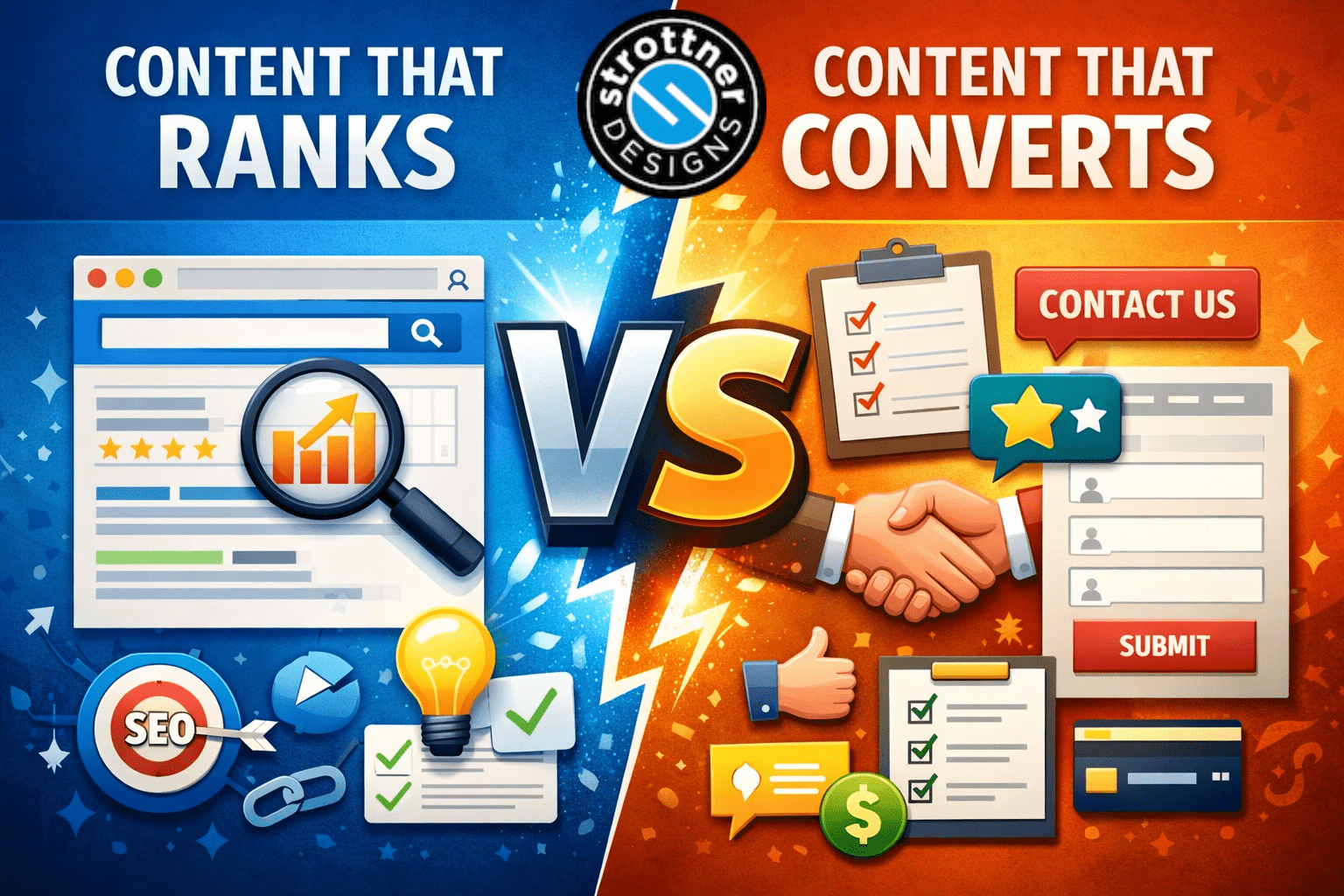
If content marketing were baseball, “content that ranks” gets you on base. “Content that converts” gets you home.
A lot of businesses confuse the two. They publish blog posts packed with keywords, watch traffic go up, and then wonder why the phone stays quiet. Others go the opposite direction. They build sales pages that ask for the deal before the visitor even knows who they are. That is like proposing on the first date, except with less romance and worse conversion rates.
Here’s the truth: content that ranks and content that converts are not the same thing. They have different jobs, different structures, and different success metrics. But when they work together, they create a content strategy that builds authority, drives traffic, and turns attention into revenue.
That matters even more now because search is no longer just ten blue links and a prayer. Google’s AI search experiences are built to answer longer, more specific questions, and Google has said the right approach is still to create unique, helpful, satisfying content. Microsoft is moving in the same direction. Bing now offers AI Performance reporting that shows how often content is cited in AI-generated answers across Copilot and Bing experiences, which tells you something important: being visible is no longer only about ranking. It is also about being reference-worthy.
So let’s break it down.
Content that ranks is built to earn visibility in search engines and AI-driven search experiences. Its first job is discovery.
This type of content targets questions, topics, and search intent. It is structured so search engines can understand it and users can scan it without feeling like they walked into a wall of text. Think blog posts, guides, FAQ pages, comparisons, checklists, glossaries, and location pages.
Good ranking content usually does a few things well:
It answers a real question clearly.
It matches search intent.
It uses strong headings and logical structure.
It covers the topic with enough depth to be useful.
It earns trust through experience, clarity, and relevance.
In plain English, ranking content helps people find you.
A blog titled “How Long Does SEO Take for a Local Business?” is ranking content. So is “Website Redesign Checklist for Small Businesses” or “SEO vs PPC: Which Should You Invest In First?” These topics bring in people who are researching, comparing options, or trying to understand a problem.
That traffic matters. If nobody can find your business, your best sales message is basically a billboard in a broom closet.
Content that converts is built to drive action.
Its first job is not discovery. It is decision.
This type of content helps a visitor move from “interesting” to “let’s talk.” It removes friction, answers objections, builds trust, and makes the next step feel obvious. That next step might be filling out a contact form, booking a consultation, requesting a quote, downloading a guide, or calling your office.
Conversion content often includes:
Clear value propositions
Strong calls to action
Proof, such as case studies, testimonials, or examples
Specific outcomes
Pricing context or process clarity
Language that reduces uncertainty
A service page, case study, landing page, lead magnet, proposal page, or email nurture sequence is usually conversion content.
For a design and marketing firm, a page that says “San Antonio SEO Services” is not enough. A page that explains who the service is for, what problems it solves, what the process looks like, what results clients can expect, and why Strottner is qualified to help, that page converts.
Ranking content opens the door. Conversion content gets the handshake.
Because they overlap.
A blog post can convert. A service page can rank. A case study can do both. The problem starts when people expect one page to do every job equally well.
That is like asking your receptionist to answer phones, close enterprise deals, fix the Wi-Fi, and also play jazz piano in the lobby. Technically impressive, but not a great system.
Ranking and conversion sit on the same path, but they serve different moments in the buyer journey.
Ranking content supports the awareness and consideration stages.
Conversion content supports the consideration and decision stages.
You need both, and you need them connected.
Ranking content usually targets informational intent.
The visitor wants to learn something, solve a problem, compare options, or understand terminology. They are searching phrases like:
Conversion content usually targets commercial or transactional intent.
The visitor is closer to action. They are searching phrases like:
One group is asking, “What do I need?”
The other is asking, “Who can help me do it?”
That difference changes the entire page.
Ranking content answers questions like:
Conversion content answers questions like:
That last question is always there, even if nobody says it out loud.
A ranking piece is usually judged by:
A conversion piece is judged by:
This is where many teams get lost. They celebrate traffic that never turns into pipeline. Or they kill a blog post because it “doesn’t convert,” even though its real job is to bring the right people into the funnel.
Not every page should close the sale. Some pages should start the conversation.
Let’s say Strottner publishes a blog post called:
“SEO, PPC, or Social Media: Which Marketing Channel Should a Small Business Prioritize First?”
That topic has strong ranking potential because it matches how business owners actually search. It can attract people who are comparing options and trying to spend smarter.
To rank well, the piece should:
That post earns attention because it is helpful, relevant, and built around intent. Google’s guidance for AI search experiences emphasizes unique, non-commodity content that satisfies visitors, especially as users ask more detailed questions and follow-ups.
Now, can that post convert too? Yes, but not by turning into a late-night infomercial halfway through. It converts by naturally guiding the reader to the next step:
“Need help deciding where to invest first? Talk with our team and we’ll help you choose a strategy based on your market, goals, and budget.”
That is a conversion assist, not a hard sell.
Now picture the service page for San Antonio SEO Services.
This page is not trying to answer every broad SEO question on earth. It is built for the person who already knows they need help and is deciding who to hire.
So the page should focus on:
This is where our positioning matters. Our site already frames us as an experienced, award-winning, full-service boutique firm serving San Antonio, South Texas, and beyond, with over 20 years of experience across web design, logo design, SEO, PPC, social media, and video marketing.
That is conversion fuel. Experience builds confidence. Breadth of service supports strategy. Boutique positioning suggests personal attention without bloated agency overhead. That is not chest-thumping. That is clarity.
Traffic is not the same as traction.
You can rank for a dozen useful keywords and still end up with a content program that behaves like a busy restaurant with no waitstaff. Lots of people come in. Nobody gets served.
This usually happens for one of three reasons:
First, the traffic is not qualified. You brought in curious readers, not buyers.
Second, the content does not create a next step. The reader finishes the article and has nowhere to go.
Third, the site experience breaks trust. Weak service pages, vague messaging, dated design, and buried calls to action can waste great organic traffic.
That is why content strategy cannot live in a silo. SEO, copy, UX, design, and conversion planning all have to work together. Conveniently, that is exactly the kind of integrated work a design and marketing firm should be doing in the first place.
Because people cannot hire you if they never meet you.
A site full of service pages with strong calls to action can still struggle if it has no top-of-funnel content. Without educational content, you miss the chance to earn trust early, answer questions before your competitors do, and show up when prospects start researching.
You also miss visibility in AI search environments that cite strong informational content. Bing’s new AI Performance reporting is a clear sign that publishers should pay attention not only to clicks, but to which pages are cited, which queries ground those answers, and how clarity and completeness affect inclusion.
Put simply, if conversion content is your closer, ranking content is your lead guitarist. You can survive without one for a while, but the show gets weird fast.
The best strategy is not choosing one over the other. It is designing the relationship between them.
Here’s the practical model:
Write educational content around the real questions your audience asks before they buy. Focus on helpful, specific topics, not generic recycled mush. If a sentence could appear on 400 other marketing blogs without changing a word, it is probably too bland to win.
Every strong blog post should point readers toward relevant service pages, case studies, FAQs, or contact options. Make the next step feel natural.
You do not need to turn every article into a sales pitch, but you should include the occasional bridge: a short CTA, a relevant proof point, or a brief example that shows you do this work for real clients.
Do not stop at “we offer SEO.” Explain the business case, the process, the timeline, the deliverables, and why your approach works.
If a page ranks but does not assist conversions, improve the CTA, internal links, and relevance to services. If a service page converts but does not attract traffic, support it with topic clusters and stronger SEO structure.
Ranking content earns attention.
Conversion content earns trust.
Together, they earn business.
That is the difference.
One gets you found. One gets you chosen.
And in the age of AI search, the gap matters even more. Search platforms are rewarding content that is clear, useful, original, structured, and trustworthy. Google has been explicit that the focus is on quality and helpfulness, not whether content was produced with AI or by hand, and its AI search guidance pushes creators toward unique content that truly satisfies searchers. If your content is shallow, generic, or built only to please an algorithm, it will struggle to stand out, whether a human sees it in search results or an AI system decides whether to cite it.
So no, content that ranks and content that converts are not the same thing.
But they should absolutely be on the same team.
The smartest content strategies do both: they attract the right audience, guide them through the decision process, and make the next step feel easy.
At Strottner Designs, that is where design, messaging, SEO, and strategy meet. Not as separate boxes. As one system built to help businesses get found, build trust, and grow. That matches how we operate: experienced, full-service, boutique, and focused on helping businesses grow through design and marketing.
Because traffic without conversion is noise.
And conversion without visibility is wishful thinking.
Need content that does more than fill space?
At Strottner Designs, we create content strategies that help businesses get found, build trust, and turn traffic into leads. Whether you need SEO-driven blog content, stronger service pages, or a website that converts, our team can help. Contact us today!

Interested in a new site and SEO, or just a new site? Visit Home of the Free Website to learn how we can build you a free or affordable site.

Privacy Policy | Sitemap | Terms of Use