
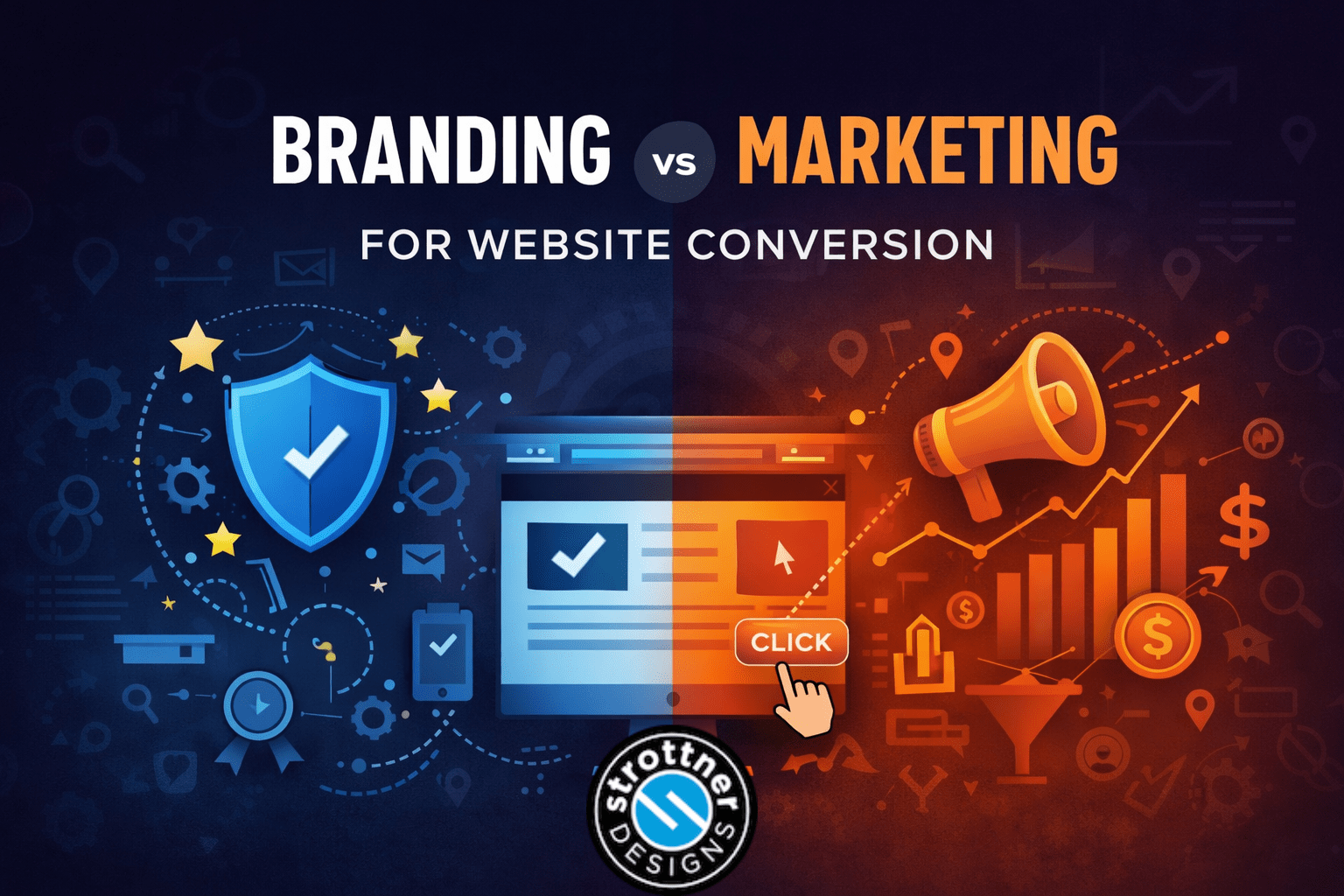
If your website isn’t converting, it’s rarely because you “need more traffic.” It’s usually because traffic is arriving with questions, and your site isn’t answering them quickly enough, clearly enough, or confidently enough. Branding and marketing fix different parts of that problem: branding makes you believable, marketing makes you findable and compelling.
Here’s the simplest way to think about it. Branding is the long-term work of shaping how people perceive you, while marketing is the set of activities that drives awareness and immediate action (clicks, sign-ups, purchases). The American Marketing Association[1] draws this line explicitly, and even calls out how branding and marketing “go hand in hand” while serving different roles. [2]
The “both” part matters because trust and friction have direct, measurable effects on conversion. Nielsen Norman Group[3] notes that trust is essential to a user’s willingness to risk time, money, and personal data on a website. [4] And a 2024 meta-analysis found trust significantly influences e-commerce purchasing decisions (alongside perceived risk and other factors). [5] Performance is also a conversion lever: a 2022 analysis found conversion rates drop sharply as load time increases. [6]
This guide defines branding vs marketing clearly, then shows how each affects website conversion through trust signals, UX, messaging, funnel design, and CRO practices like analytics and testing. It ends with a practical roadmap, tools, and ways Strottner Designs can help.
Budgets, industries, and regions weren’t specified, so this article assumes a typical small-to-mid-sized business website that needs to generate leads, appointments, or online sales. It also assumes your audience is researching, comparing options, and returning to your site more than once before deciding, which aligns with modern buying behavior research. [7]
It also assumes you want visibility and conversion in both classic search and AI-shaped search experiences (think Google AI Overviews and Microsoft Copilot). Google[8] is actively changing how AI Overviews and AI Mode present links and sources, but the goal for your website stays the same: earn attention, earn trust, then make action easy. [9]
Branding and marketing get confused because they arrive at the same place: your website. You run an ad (marketing), someone clicks, and then they make a split-second judgment about whether you’re legitimate (branding). After that, they either convert or they disappear like they were only ever a vibe.
A useful starting point is the AMA’s definitions. Marketing is “the activity, set of institutions, and processes for creating, communicating, delivering, and exchanging offerings that have value…” [10] A brand is an identifying feature (name, term, design, symbol), and the AMA references ISO[11]’s view of a brand as an intangible asset designed to create distinctive associations that generate economic benefit. [10]
Here’s the website-friendly translation:
The AMA spells out the relationship in plain terms: marketing pushes immediate action, branding shapes long-term perception and amplifies marketing’s impact. [12]
Branding shows up as:
Marketing shows up as:
If one is missing, conversion usually tanks. Branding without marketing can look great but feel vague. Marketing without branding can drive clicks, then lose users the moment the page loads.
Example: strong marketing, weak branding. You run ads and SEO, traffic shows up, and then users hesitate because the site feels generic or inconsistent. You’ll see decent click-through rates but poor lead quality and low conversion.
Example: strong branding, weak marketing. The site looks great and people trust it, but the offer isn’t clear and there’s no obvious next step. You’ll hear “your website is beautiful,” while your calendar stays weirdly open.
Branding influences conversion because it changes perceived risk. Online purchases and lead forms are inherently trust transactions: users choose to risk money, time, or personal data. That’s why NN/g’s trust research is so blunt: lose trust and you lose the sale. [4]
This isn’t just a UX opinion. A 2024 meta-analysis found that trust significantly influences consumer e-commerce purchasing decisions, and it frames perceived risk as a key factor in the trust-to-purchase relationship. [5] Translation: trust isn’t fluffy, it’s measurable.
Trust isn’t one thing. It’s a stack of small “green lights” that reduce doubt.
The trust cues with outsized conversion impact tend to be:
Trust has a direct relationship to business outcomes. Edelman[13] reports that consumers who fully trust a brand are more likely to purchase it, advocate for it, and stay loyal. [14] That’s branding translating into measurable conversion, retention, and word of mouth.
Consistency reduces mental load. Users don’t have to wonder if they’re in the right place, or if the page is stitched together from different eras of your business.
Recent brand-consistency analysis from Marq[15] reports that consistent brand presentation is associated with an average 10–20% revenue increase. [16] You don’t need to hit a specific number for the takeaway to matter: consistency isn’t cosmetic, it can pay for itself.
Accessibility is part of professionalism. If someone can’t read your text, tap your buttons, or complete your form on mobile, they won’t convert, even if they want to.
The World Wide Web Consortium[17] maintains WCAG, the international accessibility standard, including WCAG 2.2. [18] Treat accessibility as a brand statement: “We care enough to make this usable.” That’s a trust cue you don’t have to explain.
Branding builds trust, but trust doesn’t automatically create momentum. Marketing is what focuses attention, clarifies the next step, and turns “this seems legit” into “I’m booking a call.”
It’s also the part that can get awkward if it’s too aggressive. Your goal isn’t to turn your homepage into an infomercial. Your goal is to guide the right person to the right next click.
The classic funnel is useful for planning, but it doesn’t describe real behavior well anymore. Edelman’s research explicitly says buying behavior is too dynamic for a linear funnel, and that purchase is often the beginning of an ongoing relationship. [19]
On a website, that means you need multiple entry points and multiple “good next steps.” People drop in on service pages, pricing pages, and blog posts. They leave, they come back, they forward links to a spouse or boss, and then they decide.
Most conversion problems come down to missing structure, not missing creativity.
A conversion-ready website usually includes:
Marketing also includes personalization, but it should be used like seasoning, not like ketchup on everything. McKinsey & Company reports that personalization most often drives 10–15% revenue lift (with wide variation by sector and execution). [20] If your fundamentals are messy, personalization just helps people bounce faster.
This is where most businesses get stuck. They’ll redesign the logo or start running ads, then wonder why leads didn’t change. Your website is the integration point. It has to deliver the marketing promise using branding-led trust, then move users through a practical conversion path.
Google’s guidance aligns with this direction. Its documentation on people-first content emphasizes that ranking systems are designed to prioritize helpful, reliable information created to benefit people. [21] That’s also the easiest way to build trust with actual humans, which is nice.
AI-powered search is making “credibility” and “helpfulness” less optional. Google’s quality rater guidelines framework is often summarized as E-E-A-T (experience, expertise, authoritativeness, trustworthiness), and Google has publicly noted the addition of “Experience” to that concept. [22]
On a practical website level, that means your branding and marketing content should show real-world proof, not just claims. Add author or team bios where relevant, explain your process, publish case studies with specifics, and use real photos of your work. Those signals help humans trust you, and they also help search systems interpret you as a legitimate entity worth surfacing. [23]
You can apply this to almost any page:
If your page is missing one of these, conversion usually suffers. If it has all three, then you can optimize.
Page experience is not just technical SEO. It’s conversion infrastructure.
Google’s documentation is clear that there’s no single “page experience signal,” but Core Web Vitals are used by Google’s ranking systems, and Google recommends achieving good Core Web Vitals for Search success and user experience. [24] Core Web Vitals measure loading, responsiveness, and visual stability, and Google provides targets like LCP within 2.5 seconds and INP under 200 milliseconds. [25]
Google also replaced FID with INP as a Core Web Vitals metric effective March 2024. [26] This matters for conversion because slow, jumpy, unresponsive pages feel untrustworthy. It also matters financially: a 2022 study reported steep conversion-rate drop-offs as load time increases. [6]
Search is becoming more answer-like, and your site needs to be easy to interpret. Google explains that structured data provides explicit meaning about a page and can enable richer search results that encourage interaction. [27] Google even lists case studies with tangible lifts: for example, Rotten Tomatoes[28] measured a 25% higher click-through rate on pages enhanced with structured data, and Food Network[29] reported a 35% increase in visits after enabling search features across pages. [27]
On the AI side, Microsoft[30] recommends using schema markup, FAQs, and structured data to improve contextual understanding in AI-powered search. [31] The goal isn’t “schema hacks,” it’s clarity.
Google also warns that generative AI content is fine when it adds value, but generating large volumes of pages without value can violate its spam policies on scaled content abuse. [32] So yes, use AI to help, but don’t turn your website into a content spam factory.
For e-commerce, checkout UX is where branding and marketing either cash in or fall apart.
Baymard Institute[33] reports that around 70% of e-commerce users abandon after adding items to a cart, and that the average large e-commerce site can gain up to a 35% increase in conversion rate by making design changes to checkout. [34] Baymard also notes that nearly 1 in 5 shoppers abandon because checkout is too long or complicated, and that many checkouts can reduce form elements substantially. [35]
Even if you don’t sell online, your intake form is your “checkout.” Treat it like a product. Reduce fields. Explain what happens next. Confirm submission clearly. Then follow up fast.
You can’t improve what you don’t track. You also can’t track everything without going cross-eyed. The trick is picking a few KPIs that reflect branding health, marketing performance, and conversion friction.
Branding metrics tend to be indirect, but they’re not imaginary:
Edelman’s research connects trust to purchase, loyalty, and advocacy, which are outcomes your website can measure through conversion and retention signals. [36]
Marketing KPIs should map cleanly to your funnel:
If you don’t segment performance by channel, it’s too easy to “fix the website” when the real issue is targeting, offer-fit, or follow-up.
These metrics tell you if the site is getting easier to use:
And yes, performance belongs here too. Google explicitly recommends achieving good Core Web Vitals for user experience and Search success, while noting that chasing perfect scores purely for SEO isn’t the goal. [24]
| Goal | Tools | Why it matters |
| Analytics + KPIs | Google Analytics 4, Google Search Console | Know what’s happening, where users drop off, and which channels are worth money. |
| Behavior insights | Microsoft Clarity, Hotjar[37] | Watch sessions, find friction, and spot usability issues quickly. |
| A/B testing | VWO[38], Optimizely[39] | Test changes instead of guessing; A/B testing is a widely used conversion improvement method. [40] |
| Performance | PageSpeed Insights, Lighthouse WebPageTest | Improve Core Web Vitals and stabilize UX. [24] |
| SEO + content | Screaming Frog[41], Semrush[42], Ahrefs[43] | Build intent-driven content and fix technical SEO problems. [21] |
| Design systems | Figma[44], Adobe[45] Creative Cloud | Keep brand consistency across web and marketing assets. [16] |
| Website Area | Branding impact | Marketing impact | Typical conversion effect |
| Hero section | First impression + credibility | Align offer to intent | Higher scroll and CTA clicks |
| Visual identity | Consistency lowers perceived risk | Cohesion across campaigns | Higher form completion |
| Messaging | Voice clarifies and builds trust | Positioning adds relevance | Higher conversion rate [46] |
| UX and navigation | Predictable and polished | Guides next step | Lower bounce; more leads |
| Speed and stability | Feels reliable | Protects paid traffic ROI | More sales; fewer drop-offs [47] |
| Proof elements | Builds belief | Supports campaign claims | Less hesitation [48] |
| Business type | Priority wins | Typical timeline | Focus |
| Solo / local | Message clarity, proof, fast scheduling, speed fixes | 2–4 weeks | One conversion goal (calls or booking). |
| Multi-location SMB | Brand system, location pages, unified analytics, CRM follow-up | 4–8 weeks | Standardize templates to reduce variability. |
| Enterprise | Governance, performance at scale, experimentation, personalization | 8–16 weeks | Scaling learning, not just pages. [20] |
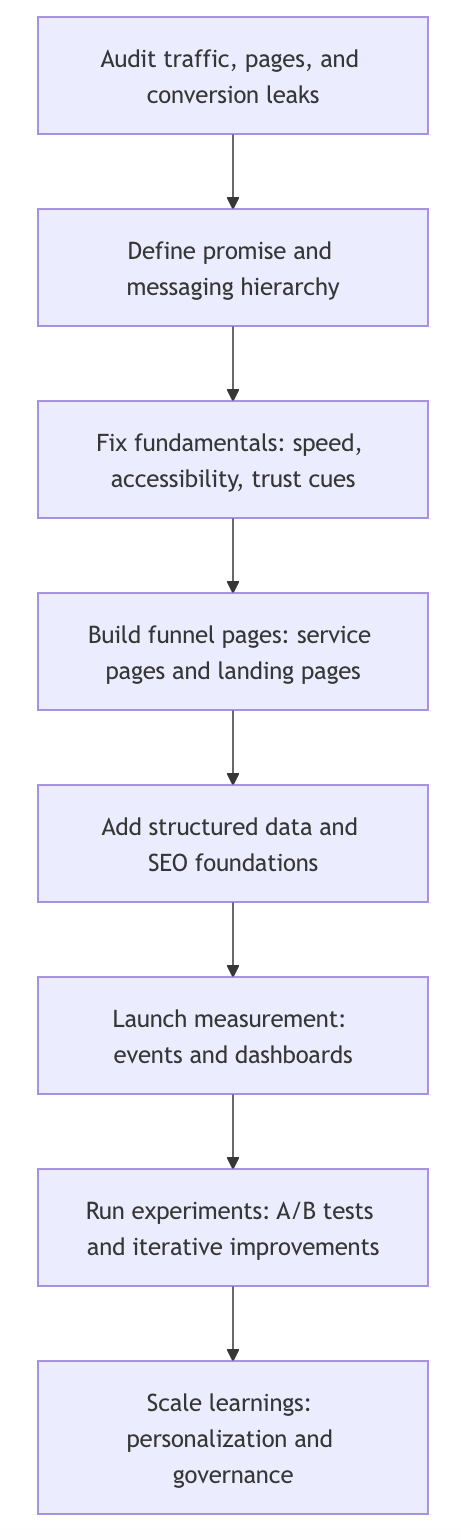
Phase one: clarity and trust (first two weeks).
Fix the hero on your top pages, add proof, tighten your offer, and make the main CTA unmissable. Reduce friction in forms and scheduling. Start collecting reviews and testimonials.
Phase two: performance and UX (weeks two to four).
Improve Core Web Vitals and fix the biggest usability issues. INP is now a Core Web Vitals metric, so responsiveness matters. [49] Apply accessibility basics using WCAG guidance. [18]
Phase three: marketing architecture (month two).
Build landing pages for your highest-value campaigns, create search-intent service pages, and set up follow-up paths (email, remarketing, FAQs). Add structured data where it fits, and keep it truthful and visible. [50]
Phase four: optimization and scaling (month three and beyond).
Establish an experiment backlog, run tests, and iterate. Add personalization only after the basics are steady; McKinsey’s research suggests personalization can drive meaningful lift, but execution is everything. [51]
AI is changing the search landscape quickly. Google is actively updating how AI Overviews and AI Mode present links, and the whole ecosystem is pushing sites toward clarity, usefulness, and trust. [9]
Branding builds the trust. Marketing builds the path. Your website is where they shake hands and actually do the job.
If your website isn’t converting, the answer usually isn’t “more traffic.” It’s alignment.
Alignment between what you promise and what people see.
Alignment between the trust you project and the action you ask for.
Alignment between branding, marketing, and the actual experience of using your site.
Branding lowers perceived risk.
Marketing creates momentum.
Your website is where those two forces either work together or quietly cancel each other out.
When branding is strong but the path is unclear, visitors stall.
When marketing is aggressive but trust is weak, visitors hesitate.
When both are intentional, structured, and supported by performance and usability, conversion becomes predictable.
That’s the real shift.
You stop thinking in isolated fixes, like “we need better ads” or “we need a new logo.”
You start thinking in systems:
Clear promise
Credible proof
Frictionless path
Measured performance
Continuous improvement
That system works whether traffic comes from Google search, AI Overviews, paid ads, social media, or direct referrals. It works because it’s built around how people actually decide: they look for relevance, they scan for trust, and they choose the easiest next step.
You don’t need a louder website.
You need a clearer one.
You don’t need to chase every algorithm update.
You need to earn attention, earn trust, and make action simple.
If you focus on that, traffic becomes more valuable. Leads get better. Sales feel less forced. And your website stops being a digital brochure and starts acting like a reliable part of your growth engine.
Branding builds belief.
Marketing builds movement.
Conversion happens when they finally work as one.
And we can help you with all of it.

Interested in a new site and SEO, or just a new site? Visit Home of the Free Website to learn how we can build you a free or affordable site.
[1] [40] https://vwo.com/conversion-rate-optimization/conversion-rate-optimization-statistics/
https://vwo.com/conversion-rate-optimization/conversion-rate-optimization-statistics/
[2] [12] https://www.ama.org/marketing-news/what-is-branding-a-complete-guide-for-marketers-in-2025/
https://www.ama.org/marketing-news/what-is-branding-a-complete-guide-for-marketers-in-2025/
[3] [9] https://www.theverge.com/tech/880475/google-ai-overviews-ai-mode-links-update
https://www.theverge.com/tech/880475/google-ai-overviews-ai-mode-links-update
[4] [38] [48] https://www.nngroup.com/reports/ecommerce-ux-trust-and-credibility/
https://www.nngroup.com/reports/ecommerce-ux-trust-and-credibility/
[5] [13] [39] [46] https://www.sciencedirect.com/science/article/pii/S2405844024057451
https://www.sciencedirect.com/science/article/pii/S2405844024057451
[6] [15] [44] [47] https://www.portent.com/blog/analytics/research-site-speed-hurting-everyones-revenue.htm
https://www.portent.com/blog/analytics/research-site-speed-hurting-everyones-revenue.htm
[7] [19] https://www.edelman.com/trust/2023/trust-barometer/special-report-brand-trust
https://www.edelman.com/trust/2023/trust-barometer/special-report-brand-trust
[8] [11] [24] [28] [45] https://developers.google.com/search/docs/appearance/page-experience
https://developers.google.com/search/docs/appearance/page-experience
[10] [29] https://www.ama.org/the-definition-of-marketing-what-is-marketing/
https://www.ama.org/the-definition-of-marketing-what-is-marketing/
[14] [36] https://www.edelman.com/sites/g/files/aatuss191/files/2024-06/Top10_Edelman_2024BrandTrust.pdf
https://www.edelman.com/sites/g/files/aatuss191/files/2024-06/Top10_Edelman_2024BrandTrust.pdf
[16] [30] https://www.marq.com/blog/brand-consistency-competitive-advantage/
https://www.marq.com/blog/brand-consistency-competitive-advantage/
[17] [21] [23] [43] https://developers.google.com/search/docs/fundamentals/creating-helpful-content
https://developers.google.com/search/docs/fundamentals/creating-helpful-content
[18] [52] https://www.w3.org/WAI/standards-guidelines/wcag/
https://www.w3.org/WAI/standards-guidelines/wcag/
[20] [33] [42] [51] https://www.mckinsey.com/capabilities/growth-marketing-and-sales/our-insights/the-value-of-getting-personalization-right-or-wrong-is-multiplying
[22] https://developers.google.com/search/blog/2022/12/google-raters-guidelines-e-e-a-t
https://developers.google.com/search/blog/2022/12/google-raters-guidelines-e-e-a-t
[25] https://developers.google.com/search/docs/appearance/core-web-vitals
https://developers.google.com/search/docs/appearance/core-web-vitals
[26] [41] [49] https://developers.google.com/search/blog/2023/05/introducing-inp
https://developers.google.com/search/blog/2023/05/introducing-inp
[27] [37] [50] https://developers.google.com/search/docs/appearance/structured-data/intro-structured-data
https://developers.google.com/search/docs/appearance/structured-data/intro-structured-data
[31] https://about.ads.microsoft.com/en/blog/post/april-2025/mastering-ai-powered-search-next-level-strategies-for-marketers
[32] https://developers.google.com/search/docs/fundamentals/using-gen-ai-content
https://developers.google.com/search/docs/fundamentals/using-gen-ai-content
[34] https://baymard.com/blog/current-state-of-checkout-ux
https://baymard.com/blog/current-state-of-checkout-ux
[35] https://baymard.com/lists/cart-abandonment-rate

Privacy Policy | Sitemap | Terms of Use